Slab Leak Detection & Repair in Anaheim, CA
Anaheim's housing tells the story of postwar Southern California: street after street of 1950s–1970s ranch homes on slab-on-grade foundations, with original copper water lines now pushing sixty-plus years old. From West Anaheim and the Colony District to the condo corridors near Disneyland, those aging lines run through concrete that has spent decades shifting on coastal-plain clays — with the occasional earthquake to hurry things along. By the time a homeowner notices a warm patch of tile, a water bill that doubled for no reason, or the faint sound of running water behind a wall, the leak has usually been active for weeks. Our Anaheim slab leak detection team works same-day across Orange County, using acoustic listening and thermal imaging to pinpoint the break within inches. Precise location is everything: it is the difference between opening one square foot of slab and tearing up half a room.
Neighborhoods We Serve in Anaheim
Anaheim Hills, Peralta Hills, West Anaheim, Downtown Anaheim (Colony District), The Canyon, Platinum Triangle, Brookhurst, Euclid — and every ZIP code in between.
Why Anaheim Homes Get Slab Leaks
Anaheim sits on the coastal plain's clay-rich alluvial soils, which expand when wet and shrink as they dry — a slow seasonal heave that works on slab foundations year after year. The area is also active seismic country; even minor tremors can jolt already-corroded copper joints under the slab. Most of the city's housing went up in the 1950s–1970s boom as slab-on-grade tracts with copper lines cast directly into the foundation — pipe that is now well past its design life. Water here is moderately hard, and in the hillside zones of Anaheim Hills, high static water pressure adds another stressor that shortens copper's lifespan.
How We Detect Slab Leaks in Anaheim
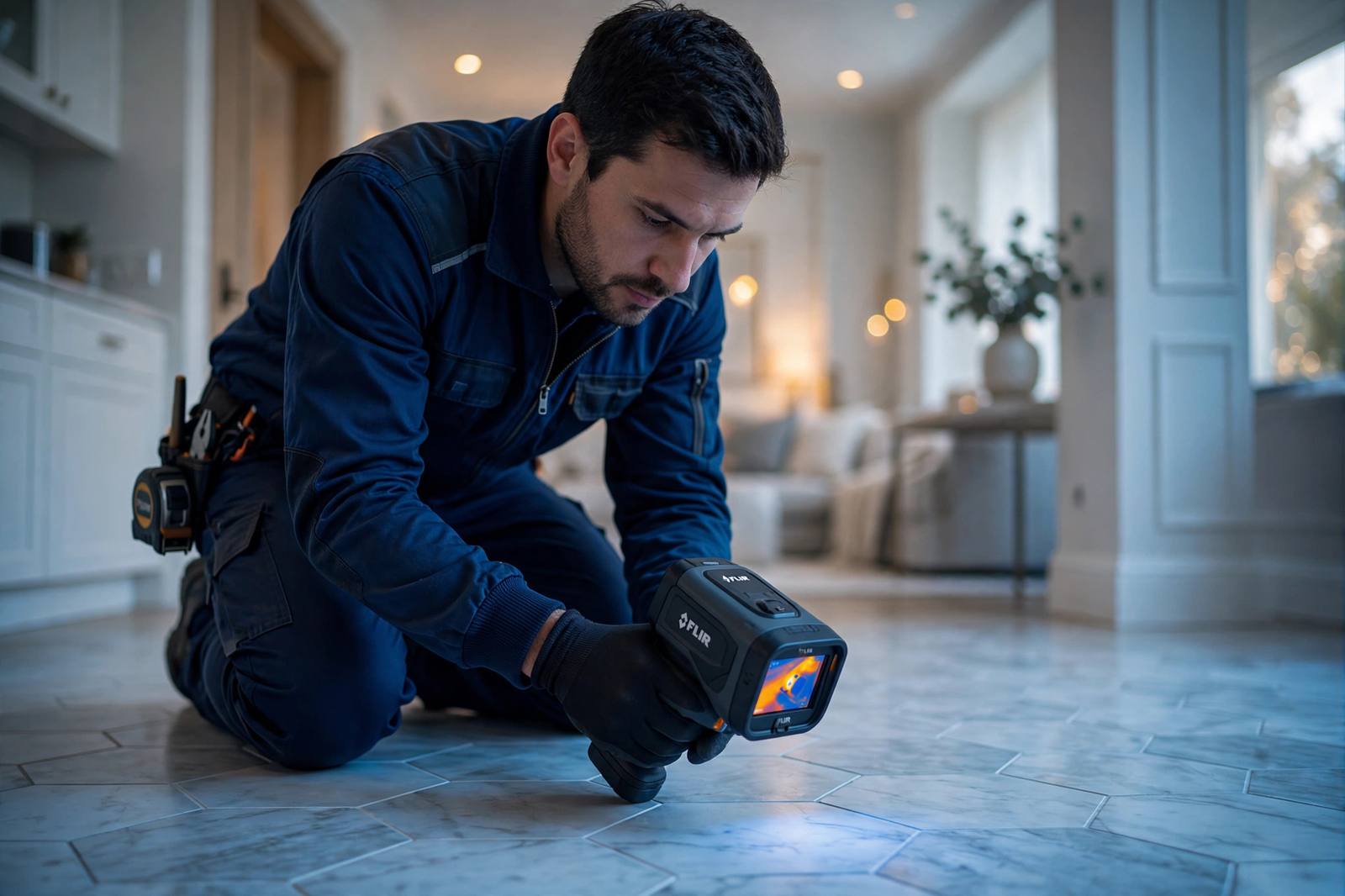
Think of detection as detective work with specialized instruments. We start by interrogating the plumbing with pressure: isolating the hot-water system from the cold and watching precision gauges. If the hot side bleeds pressure while the cold holds steady, we know the leak is on a hot line — and we know it in about ten minutes, without touching a floor. That one test eliminates half the suspects. Next we listen. Pressurized water escaping through a pinhole or cracked fitting produces a high-frequency hiss, and our ground microphones and electronic amplifiers pick it up through six inches of concrete. We map the loudest points across the slab the way a surveyor triangulates — the peak of the sound field is usually within a foot or two of the break. Then the infrared camera comes out. A hot-water leak blooms on thermal imaging as a bright, spreading shape against the cooler slab, and in Anaheim's mild climate that contrast reads beautifully on tile, stone and even carpet. We sweep room by room and mark the footprint in tape before any repair conversation begins. For drain lines, which don't hold pressure, we send waterproof cameras down the pipe to see breaks, bellies and root intrusion firsthand — common in Anaheim's 1950s–1960s cast-iron systems. And when a supply leak is too quiet for microphones, tracer gas (a harmless hydrogen-nitrogen mix) escapes at the break and rises through the concrete for our sniffer to find. Most Anaheim homes are fully diagnosed in one to two hours, and you receive a marked location, photos and a written report — documentation that HOA boards, property managers and insurance adjusters accept without argument.
Signs of a Slab Leak in Anaheim Homes
Anaheim's ranch homes give slab leaks away if you know what to look for. The signature clue is a warm spot on the floor — tile in a hallway or kitchen that feels heated while the surrounding floor is cool. That is a hot-water line leaking directly beneath. Cold-line leaks announce themselves differently: carpet that stays damp along one edge, a musty odor in a closet, laminate planks that cup or separate, or white mineral crust forming where water wicks up through the slab. Watch your Anaheim Public Utilities bill the way you'd watch a smoke detector. A 30–50% jump with no change in watering or household size is one of the most reliable early warnings there is. Other signs: the sound of running water when every tap is off, a water heater that fires far more often than it should, a sudden drop in pressure at one group of fixtures, and new cracks in the driveway, patio or stucco that suggest the soil under the slab is moving. For businesses along the commercial corridors near Disneyland and the Platinum Triangle, the stakes are higher — a slab leak under a restaurant or retail space can force a shutdown, so an unexplained water bill there deserves a same-day call, not a wait-and-see. One Anaheim-specific note: many homes here have additions and converted garages where newer plumbing ties into the original 1960s lines. Those transition joints are frequent failure points, so pay extra attention to floors near the old-to-new boundary.
Why Anaheim Homes Get Slab Leaks
Anaheim's risk profile starts with its dirt. The city sits on the coastal plain's clay-rich alluvial soils, which swell when winter rains arrive and shrink through the dry months. That slow seasonal heave works on slab foundations year after year, flexing the copper lines cast inside them. Layer on Southern California seismicity: even minor tremors can jolt fittings and joints in pipe that is already thinned by decades of corrosion, turning a weak spot into an active leak. Then consider the housing stock. The great Anaheim building boom ran from the 1950s through the 1970s, and nearly all of it went up slab-on-grade with copper distribution lines buried directly in the foundation. That pipe is now 50 to 70 years old — past the realistic service life of copper in contact with concrete and mineral-bearing water. Anaheim's water is moderately hard, and hardness plus time equals interior scaling and pitting, the precursor to pinholes. The city's east side tells a different chapter: Anaheim Hills and the canyon areas developed from the 1980s onward on graded hillsides, where high static water pressure is the enemy. Elevation can push household pressure well above 80 psi, and when a pressure regulator fails — as they do every 10 to 15 years — that hammering pressure shortens the life of every copper joint in the house. So Anaheim gets slab leaks from both ends of the timeline: genuinely old pipe in the flats, and pressure-abused newer pipe in the hills.
Slab Leak Repair Options in Anaheim
Once we have marked the leak, the repair conversation comes down to the pipe's overall condition. Direct-access repair — opening the slab at the marked point, cutting out the failed section, patching the concrete — is the economical choice when the rest of the system is sound. In a 1990s Anaheim Hills home with one bad fitting, that is usually the right call: a day of work and you are done. Rerouting is the workhorse fix for older Anaheim homes. We abandon the failing under-slab lines and run new PEX or copper through walls and the attic, leaving the slab untouched. In 1950s–1970s West Anaheim and downtown-area homes where the original copper is comprehensively aged, a reroute ends the cycle of one pinhole after another. Anaheim's mild climate is actually a plus here — attics don't hit the brutal temperatures of the Central Valley, so overhead reroutes are straightforward. Epoxy pipe lining is the third option: the interior of the existing lines is cleaned and coated, sealing pinholes and corrosion without opening floors or walls. It fits homeowners who want to preserve original tile or hardwood that would be destroyed by slab access. A fourth consideration in Anaheim is the condo and townhome stock near the resort corridor: repairs there often involve HOA approvals, common-area lines and coordinated shutoffs, so the written detection report matters as much as the repair itself. Whatever the method, the City of Anaheim requires permits for most repiping work — a legitimate contractor pulls them, schedules the inspection, and builds that into the timeline.
Anaheim Hills vs. Older Anaheim: Different Eras, Different Risks
It helps to think of Anaheim as two different plumbing cities. In the flats — West Anaheim, the Colony District, the neighborhoods around Brookhurst and Euclid — the housing is predominantly 1950s–1970s slab-on-grade ranch homes with original copper now 50-plus years old and cast-iron drain lines of the same vintage. Here the failure mode is age: pinhole leaks in water lines, and drain lines with root intrusion, scale buildup and joints offset by decades of clay-soil movement. Detection in these homes leans heavily on acoustic listening and camera inspection, and repair conversations usually center on rerouting versus lining, because spot-fixing one section of sixty-year-old copper is often just a down payment on the next leak. In Anaheim Hills, Peralta Hills and the Canyon, the story flips. These are 1980s–2000s homes, many with post-tension slab foundations — a different structural system where cutting the slab requires an engineer-aware approach, since nicking a tension cable is dangerous and expensive. The dominant risk isn't age but pressure: hillside elevation drives high static water pressure, and failed regulators quietly hammer joints for years before anything shows. Detection here starts with a pressure reading at the hose bib — anything sustained above 80 psi is a red flag — and repairs must respect the post-tension slab. The takeaway: a plumber who treats a 1962 West Anaheim ranch and a 1998 Anaheim Hills two-story as the same job is guessing. The diagnostics, the repair options and even the permit path differ by era and elevation.
What Slab Leak Detection & Repair Costs in Anaheim
Orange County is one of the priciest plumbing markets in California, and Anaheim pricing reflects it. A full detection visit — pressure testing, acoustic listening, thermal imaging, written report — typically runs $195 to $525, with most single-family homes landing in the middle of that range. Tracer gas or sewer camera work adds to the total when the situation calls for it. As elsewhere, the detection fee is commonly credited toward the repair. On the repair side, a direct-access spot repair through the slab generally costs $2,400 to $4,200 in Anaheim, including the concrete patch. Flooring restoration beyond the patch — retiling, refinishing wood — is usually quoted separately, and in homes with expensive original tile that line item deserves attention. A whole-house or partial reroute, the most-recommended fix for the city's aging copper, typically runs $4,000 to $7,200 depending on fixture count, stories and attic access. Epoxy lining for a single-family home often falls between $4,500 and $6,800. Two Anaheim-specific cost factors: permit and inspection fees with the city add a few hundred dollars to repipes, and HOA-coordinated work in condos can extend timelines (though not necessarily costs). Because labor rates here exceed both the national average and inland California, getting the pinpoint detection right matters financially — every unnecessary square foot of opened slab is money. We quote flat and in writing before any work starts.
Get a Pinpoint Diagnosis in Anaheim
No jackhammer guesswork. Thermal imaging + acoustic equipment finds your leak within inches.
☎ Call (877) 762-1902Anaheim Slab Leak FAQs
How much does slab leak detection cost in Anaheim?
In Anaheim and across Orange County, expect $195 to $525 for a full detection visit — pressure testing, acoustic listening and thermal imaging, typically done in one to two hours. Prices run a bit higher than inland California because of OC labor rates. Tracer gas or sewer camera work can add to the total. The fee is usually credited toward the repair if you proceed with the same company.
Do earthquakes cause slab leaks?
They can. Southern California's frequent small tremors rarely damage sound plumbing, but they jolt joints and fittings in copper that is already thinned by decades of corrosion. After a noticeable quake, it is worth watching for the classic signs — a warm floor patch, a hissing sound, a climbing water bill — especially in 1950s–1970s homes with original under-slab lines.
My home is in Anaheim Hills and only 25 years old — am I safe?
Mostly, yes — but for different reasons. Anaheim Hills homes from the 1980s–2000s often have high static water pressure from the elevation, which stresses copper and blows out weak pressure regulators; a failed regulator can cut pipe life dramatically. They are also more likely to have post-tension slabs, which need special care during any concrete work. Newer does not mean immune — get the pressure checked.
Can you find the leak without tearing up my floors?
Yes. Detection is entirely non-invasive: we use ground microphones, infrared cameras, pressure gauges and sometimes tracer gas, all from above the floor. Nothing is cut or drilled until the leak's location is marked and you have approved a repair plan. The whole point of professional detection is to avoid exploratory demolition.
Will my HOA or insurance cover a slab leak?
It depends on your policy and your property type. Sudden, accidental pipe bursts are often covered, including access costs to reach the pipe; slow corrosion is typically excluded as wear and tear. If you own a condo or townhome, check whether the leak is in a common-area line (the HOA's responsibility) or inside your unit. Our written detection report gives adjusters and HOA boards exactly what they need.
How do I tell a slab leak from a wall or roof leak?
A slab leak shows its evidence at floor level: warm tile, damp carpet edges, water wicking up baseboards. Wall leaks stain drywall higher up and often follow rain or a plumbing fixture on the other side. Roof leaks appear after storms and usually mark ceilings. If you are unsure, a pressure test settles it fast — an under-slab supply leak will show pressure loss on an isolated line even when everything looks dry.
Nearby Cities
Slab leak pros nearbyFresno
Slab leak pros nearbyLos Angeles
Slab leak pros nearbyRiverside
Slab leak pros nearbySacramento
Slab leak pros nearbySan Diego
Slab leak pros nearby
Keep Learning
Can a Slab Leak Cause Mold? Health Risks Explained
Can a slab leak cause mold? Yes — often hidden. Learn the EPA 24-48 hour growth window, health risks, warning signs, and the right…
Copper Pinhole Leaks Under Slabs: Repair or Repipe?
Copper pinhole leaks under your slab: what causes pitting corrosion, repair vs repipe costs, and how to decide. Real numbers for f…
Does Homeowners Insurance Cover Slab Leaks?
Does homeowners insurance cover slab leaks? Usually the water damage, not the pipe itself. What's covered, exclusions, claim tips,…