Slab Leak: Tunneling vs Rerouting
When a plumber diagnoses a leak under your concrete slab, you'll usually hear two options: tunnel under the foundation to reach the pipe from below, or reroute the line overhead through walls and attic to bypass the slab entirely. Both are legitimate, professional repairs — but they differ dramatically in cost, timeline, disruption, and the situations where each shines. Tunneling preserves your floors by attacking the problem from underneath; it typically costs $4,000 to $8,000 or more and takes 2 to 4 days. Rerouting abandons the leaking line and runs new pipe above the slab; it typically costs $2,500 to $6,000 and takes 1 to 2 days. Neither is universally better. Tunneling wins when you have expensive flooring worth protecting or a leak location that favors below-slab access. Rerouting wins when your under-slab pipe is old and failing systemically, when soil conditions rule out excavation, or when you want the problem gone permanently with the least calendar time. This guide walks through exactly how each method works, the real trade-offs in dollars and disruption, and a decision framework for choosing between them.
How Tunneling Works
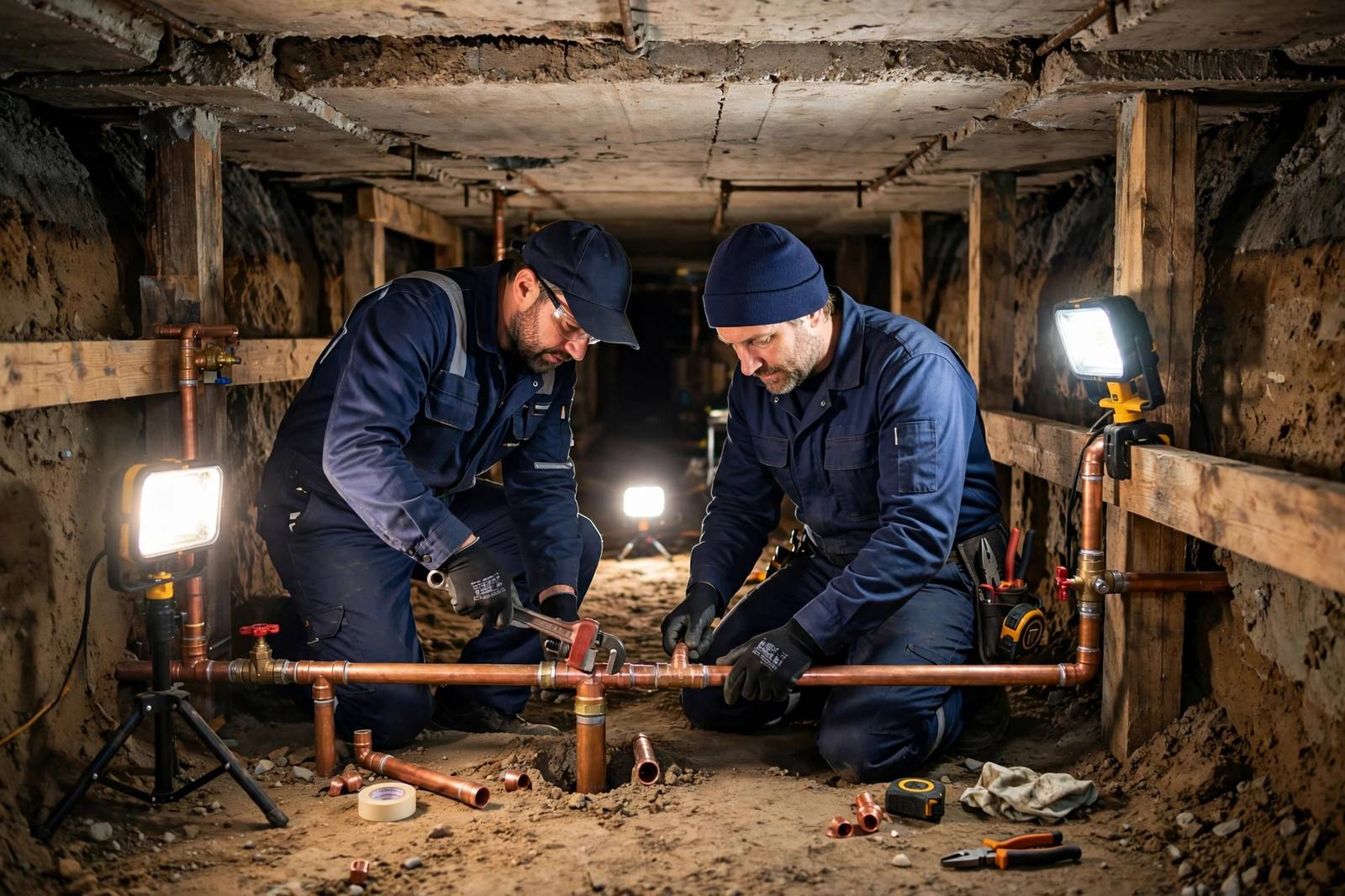
Tunneling repairs the leaking pipe from beneath the foundation. Instead of breaking through your floors, the crew digs an exterior access pit and excavates a horizontal tunnel — typically 3 to 4 feet deep and about 2 to 3 feet wide — under the slab to reach the damaged pipe from below. A worker then repairs or replaces the pipe section while lying in the tunnel, after which the tunnel is backfilled in compacted lifts and the access pit is restored. The headline benefit is obvious: your floors are never touched. For homes with travertine, hardwood, or custom tile that could cost $8,000 to $20,000 to replace, tunneling can be the cheaper total project even though the plumbing work itself costs more. The method demands specific conditions: the soil must be excavatable (rocky ground or a high water table can rule it out), there must be a sensible exterior access point, and the tunnel path must avoid utilities. Backfill compaction is the critical quality step — soil replaced in loose lifts can settle over months, potentially causing slab movement. Reputable tunneling contractors warranty their backfill against settlement, usually 1 to 5 years, and you should get that in writing. Tunnel safety is a legitimate question to ask. Professional crews shore tunnel walls to prevent collapse, maintain ventilation in longer tunnels, and keep a spotter at the access pit. Tunnels under residential slabs are typically short — 10 to 30 feet — and completed within a day of digging. If a contractor proposes an unusually long tunnel or seems casual about shoring, that's a competence signal worth heeding. Excavation is the most skill-dependent part of the method.
How Rerouting Works
Rerouting takes the opposite approach: leave the leaking pipe in the ground and run a brand-new line overhead. The plumber abandons the failed under-slab section — capping it at both ends — and routes new PEX or copper pipe through interior walls, ceilings, or attic space to reconnect the system. No concrete is broken, no soil is moved, and no tunnel is dug. The work is straightforward plumbing: opening drywall at strategic points, running the new line, pressure-testing it, and tying it in. In warm climates, attic runs are simple; in freezing climates, the new lines need proper insulation and routing through conditioned space, which adds complexity. The big strategic advantage of rerouting is that it permanently removes pipe from the hostile under-slab environment. Expansive clay soil, corrosive groundwater, and abrasion against concrete are what killed the old line — a pipe running through your attic is immune to all three. That's why rerouting is the go-to recommendation for older homes with systemic copper corrosion: you're not repairing one leak, you're retiring the entire failure-prone zone. The visible cost is drywall repair and repainting at every access point, usually handled by a separate crew over 2 to 4 days after the plumbing is done. Many reroutes now use a manifold or home-run layout: each fixture gets its own dedicated PEX line running back to a central manifold with individual shutoff valves. This costs slightly more in materials but gives you surgical control — shut off one bathroom without affecting the rest of the house — and eliminates hidden joints inside walls, since each run is continuous. If you're rerouting anyway, the manifold upgrade typically adds $300 to $800 and is widely considered worth it.
Cost Comparison: Tunneling $4,000-8,000+ vs Reroute $2,500-6,000
Let's put the numbers side by side. Tunneling typically costs $4,000 to $8,000+, driven by skilled hand excavation, shoring, and careful backfill compaction — labor-intensive work billed by the day. Rerouting typically costs $2,500 to $6,000, driven by linear feet of new pipe and the number of wall openings, plus $500 to $2,000 for drywall repair and painting afterward. On plumbing cost alone, rerouting almost always wins. But total project cost tells a different story when flooring is expensive. Breaking through a $15,000 travertine floor for a spot repair or reroute access can add $5,000 to $10,000 in stone replacement — suddenly the $7,000 tunnel that never touched the floor is the bargain. The honest comparison is total cost to 'house looks normal again,' not plumber's invoice alone. Get both quotes itemized the same way: plumbing labor, materials, excavation or drywall work, concrete or backfill restoration, flooring restoration, and permit fees. Contractors who push one method often quote the other vaguely — insist on line items. Also factor longevity: a reroute with new PEX carries a 25-year pipe warranty and eliminates future under-slab risk on that line, while a tunnel repair fixes one leak in aging pipe that may leak again nearby. Financing changes the comparison for some homeowners. Reroutes and repipes from established companies often qualify for 12-month same-as-cash or low-interest financing, while tunneling — frequently performed by smaller specialty outfits — is more often cash or check. On insurance: sudden pipe bursts are typically covered for resulting water damage, but gradual pinhole leaks and the pipe repair itself are commonly excluded. Document the failure as sudden if it genuinely was — a detection report with pressure readings is your evidence.
Disruption Compared: Noise, Dust, and Daily Life
Disruption is where homeowners feel the difference most. Tunneling keeps the mess outside and below: excavation equipment in the yard, soil piles, and several days of workers coming and going, but inside the house life goes on almost normally. The downsides are noise, dust tracked in from the access pit, and a torn-up section of yard or driveway that needs restoration. Rerouting keeps the work inside: drywall dust, workers in every room the line passes through, and water shut off during work hours. It's over faster — 1 to 2 days of plumbing — but the house feels like a construction zone during those days, and the drywall crew returns later for patching and paint. For families working from home, tunneling's exterior disruption is often easier to live with; for households that can't tolerate days of yard excavation (small lots, no exterior access), rerouting wins. Water service: both methods typically restore water each evening. Noise: tunneling's excavation is louder outdoors; rerouting's saws and hammering are louder indoors. Dust: rerouting generates fine drywall dust throughout the living space — seal off work areas with plastic sheeting regardless of which method you choose. Plan for kids and pets explicitly. Tunneling's excavation pit and equipment are hazards for curious children and dogs — fence the work area and plan to keep pets elsewhere during digging days. Rerouting's drywall dust is a respiratory irritant; anyone with asthma should stay out of active work zones, and the HVAC system should be sealed off or run on recirculate with fresh filters afterward. Neither method is dangerous when managed, but both deserve a household plan made before the crew arrives.
When Tunneling Wins
Tunneling is the right call in three situations. First, expensive or irreplaceable flooring: travertine, marble, hardwood, or discontinued tile where breaking the slab would trigger a five-figure flooring bill. Second, leak location: a leak near the slab edge or in a spot with clean exterior access tunnels efficiently, while a leak under the center of a large slab with no good access point may not. Third, structural constraints: post-tension slabs, where cutting into the concrete risks severing tension cables, make tunneling the safer engineered choice — and some post-tension warranties actually require it. Tunneling also appeals to homeowners who want the original pipe repaired rather than abandoned, though that's more psychology than engineering. The method's weaknesses: it doesn't address systemic pipe deterioration (the repaired section is new, but the rest of the old line remains), it's the most expensive plumbing option, and it depends on cooperative soil. In rocky terrain or areas with a high water table, contractors may refuse to tunnel or price it prohibitively. Always ask for the backfill compaction plan and settlement warranty in writing — that's the difference between a professional tunneling job and a future foundation problem. Historic and architecturally significant homes are strong tunneling candidates for a non-obvious reason: preservation. Plaster walls, original millwork, and period tile are difficult or impossible to restore authentically once opened for a reroute. Tunneling's exterior approach leaves historic interiors completely untouched. If your home has designated historic status, check whether the preservation board has preferences — some districts effectively require the least-invasive method, which makes the tunneling premium a compliance cost rather than a luxury.
When Rerouting Wins
Rerouting is the right call in four situations. First, systemic pipe failure: if your 30-year-old copper has produced two or more pinhole leaks, repairing individual leaks is whack-a-mole — rerouting retires the whole failing line permanently. Second, bad tunneling conditions: rocky soil, high water table, zero lot line with no exterior access, or a leak location that would require an impractically long tunnel. Third, budget: rerouting is nearly always cheaper on total project cost unless flooring is exceptionally expensive. Fourth, speed: when you need the problem solved this week, a 1-to-2-day reroute beats a 2-to-4-day tunnel plus yard restoration. Rerouting's weaknesses are cosmetic and climatic: you'll have drywall patches to paint, and in freezing climates the new overhead lines need careful insulation and routing to avoid freeze risk — a good contractor plans this explicitly rather than hoping for mild winters. One more consideration: some homeowners dislike 'abandoning' pipe in the slab on principle, but abandoned, capped lines are standard practice and pose no structural or health issue. Between the two methods, rerouting is chosen more often nationally, simply because systemic copper corrosion — not isolated damage — is the most common cause of slab leaks in older homes. Homes with polybutylene pipe — the gray plastic pipe installed in millions of homes from the late 1970s to mid-1990s — deserve special mention. Polybutylene fails systemically and unpredictably, and it was subject to class-action settlements for exactly that reason. If your slab leak is in polybutylene, rerouting or full repiping isn't just preferred, it's the only responsible answer; repairing individual polybutylene leaks is throwing money at a material the industry has already condemned.
Decision Framework: Choosing the Right Method
Here's a practical framework. Start with your pipe's age and history: one isolated leak in otherwise healthy pipe under 20 years old favors repair (tunnel or spot); two or more leaks, or pipe over 30 years old with corrosion, favors reroute or repipe. Next, price your flooring: get a flooring contractor's estimate for replacing what a slab-breaking repair would destroy, then compare tunneling's premium against that number — if the flooring costs more than the tunneling upcharge, tunnel. Next, check feasibility: ask the contractor explicitly whether your soil, water table, and lot access support tunneling, and whether your slab is post-tensioned. Then compare total timelines including restoration, not just plumbing days. Finally, get both methods quoted in writing with identical line items, and be wary of any contractor who only offers one method — single-method shops recommend what they sell. The best answer is often a hybrid: tunnel the leak under the expensive stone floor in the living room, reroute the aging line serving the bathrooms. A contractor comfortable with both methods will suggest combinations; a tunneling-only or reroute-only shop won't. Your goal isn't to pick the 'better' method in the abstract — it's to match the method to your pipe condition, your floors, your soil, and your calendar. When comparing quotes, normalize them with this checklist: is detection itemized separately or bundled; does the price include permits and inspections; who handles drywall, paint, concrete, or yard restoration and is it in the quote or a separate allowance; what are the warranty terms on labor versus materials; and what happens if the first method fails — for example, if a spot repair uncovers additional leaks. Two quotes that differ by $2,000 may differ only in what's excluded. The cheapest quote with the most exclusions is usually the most expensive job.
Talk to a Slab Leak Pro
Reading is good. A pinpoint diagnosis is better — thermal imaging and acoustic equipment find your leak within inches.
☎ Call (877) 762-1902Frequently Asked Questions
Which costs more, tunneling or rerouting?
Tunneling typically costs $4,000 to $8,000 or more, versus $2,500 to $6,000 for a reroute. Tunneling is priced by hand excavation and backfill work; rerouting is priced by pipe length and the number of walls opened.
Is rerouting a permanent fix?
Yes. Rerouting is often the recommended method for older copper systems with systemic pinhole leaks, because it abandons the failing under-slab pipe permanently instead of repairing one leak at a time.
How long does tunneling take compared to rerouting?
Tunneling adds days — usually 2 to 4 total versus 1 to 2 for a reroute — because excavation and careful backfill compaction are slow, skilled work. The backfill must be compacted in lifts to prevent future slab settlement.
Is tunneling less disruptive than rerouting?
Tunneling is quieter inside the house but still involves excavation equipment outside, soil hauling, and days of activity. Rerouting is noisier indoors (drywall cutting) but finishes faster. Neither is silent; the difference is where the disruption happens.
My plumber only offered tunneling. Should I get a second quote?
Get a second opinion. Tunneling should be recommended for a reason you can see: expensive flooring worth protecting, a leak location that favors below-slab access, or soil conditions that suit it. If the contractor can't articulate the reason, the recommendation is about margin, not your home.
Does tunneling come with a warranty?
Yes, if the backfill is properly compacted and the repair uses quality fittings. Ask whether the contractor warranties the tunnel backfill against settlement — reputable companies do, typically for 1 to 5 years.
Related Guides
Slab Leak Repair Options: 4 Methods Compared
Slab leak repair options compared: spot repair, tunneling, reroute and repipe. Real costs ($500-$15,000), pros, cons, and how to c…
How Long Does Slab Leak Repair Take? Realistic Timelines
How long does slab leak repair take? Spot repairs: 1 day. Reroutes: 1-2 days. Tunneling: 2-4 days. Realistic timelines, costs, and…
Can a Slab Leak Be Fixed Without Breaking Concrete?
Can a slab leak be fixed without breaking concrete? Yes. Rerouting, epoxy lining, and tunneling explained with real costs, timelin…