Slab Leak Detection & Repair in Colorado Springs, CO
Colorado Springs looks like the last place you'd expect plumbing trouble — a young, fast-growing city of new subdivisions with modern materials. But under Briargate, the Powers corridor, and Falcon, thousands of slab-on-grade homes sit on Front Range bentonite clay, one of the most expansive soils in the country. Add foothill drainage pushing water beneath hillside slabs, freeze-thaw cycles heaving the ground every winter, and boom-era construction that sometimes valued speed over bedding and backfill — and the Springs has a genuine slab-leak problem hiding under its new-home shine. A pinhole leak can run for months, surfacing only as a climbing Colorado Springs Utilities bill or a warm stripe across the tile. Our Colorado Springs team locates under-slab leaks with acoustic equipment, thermal imaging, and pressure testing, usually pinpointing the breach within inches on a same-day visit. New subdivision or Old Colorado City classic, you get answers fast — before a small leak becomes foundation damage.
Neighborhoods We Serve in Colorado Springs
Downtown, Old Colorado City, Broadmoor, Briargate, Powers, Falcon, Security-Widefield, Fountain, Monument, Manitou Springs — and every ZIP code in between.
Why Colorado Springs Homes Get Slab Leaks
Colorado Springs sits on Front Range bentonite clay, among the most expansive soils in America — it swells dramatically when wet and shrinks when dry, heaving slabs and fatiguing buried pipe through endless cycles. Freeze-thaw winters add a second assault, expanding waterlogged soil against foundations. Foothill lots in areas like the Broadmoor and Old Colorado City face an extra threat: hillside runoff and poor grading saturate the clay beneath slabs, keeping it swollen and shifting. Meanwhile, heavy irrigation in this semi-arid climate keeps clay wet against foundations for months. Newer subdivisions like Briargate, Powers, and Falcon are overwhelmingly slab-on-grade, putting modern PEX and copper directly in this punishing environment.
Why Colorado Springs' Newest Neighborhoods Get Slab Leaks
The newest-looking neighborhoods in Colorado Springs hide some of the oldest plumbing risks. Briargate, the Powers corridor, and Falcon were built out in waves from the 1990s through the 2020s, overwhelmingly slab-on-grade — concrete poured directly over Front Range bentonite clay. During boom cycles, production builders moved fast: trenches backfilled with the same rocky clay they excavated, pipe bedded with minimal sand cushioning, and crews under deadline pressure. That construction reality matters because PEX and copper both fail where they rub. Rocky backfill abrades tubing over years of micro-movement, and the micro-movement is guaranteed: bentonite swells when wet and shrinks when dry, and the Springs gives it both. Homeowners compound the cycle with irrigation — in a semi-arid climate, lush lawns mean constant watering, and clay that drains poorly stays saturated against the slab for months. Some 2000s-era builds also carry brass PEX fittings from the dezincification era, a known failure point now aging into its leak window. The result is counterintuitive but consistent: we locate slab leaks in 15-year-old Falcon homes nearly as often as in 1960s Security-Widefield ranches. New materials help, but new materials in moving clay, installed in a hurry, still break. If your water bill is climbing in a newer subdivision, don't let the home's age talk you out of getting it checked.
Foothill Drainage: Colorado Springs' Hidden Pipe Killer
The Springs' terrain adds a failure mode flat cities don't have. West-side and foothill neighborhoods — Broadmoor, Old Colorado City, parts of Manitou Springs — sit on graded hillside lots where gravity constantly moves water downhill and against foundations. When grading is wrong, when drainage swales fill with debris, or when downspouts dump roof water right beside the house, runoff saturates the bentonite under and around the slab. Saturated bentonite swells with tremendous force, pressing unevenly against the foundation and shifting the slab in ways level lots never experience. In winter the cycle turns destructive: waterlogged soil freezes, expands, and heaves, then thaws into soft mud that settles differentially — each freeze-thaw event flexing buried pipe a little more. Even on flatter ground east of Powers, the pattern repeats at smaller scale: uphill neighbors' irrigation, a broken sprinkler head soaking one corner of the lot for a season, or a sump-less low spot that ponds after storms. None of this excuses a failed pipe, but it explains why two identical houses can have very different leak histories — the one with water working against its slab loses. When we repair a foothill leak, we always talk drainage too, because fixing the pipe without addressing the water that attacked it invites a repeat performance.
Signs of a Slab Leak in Colorado Springs Homes
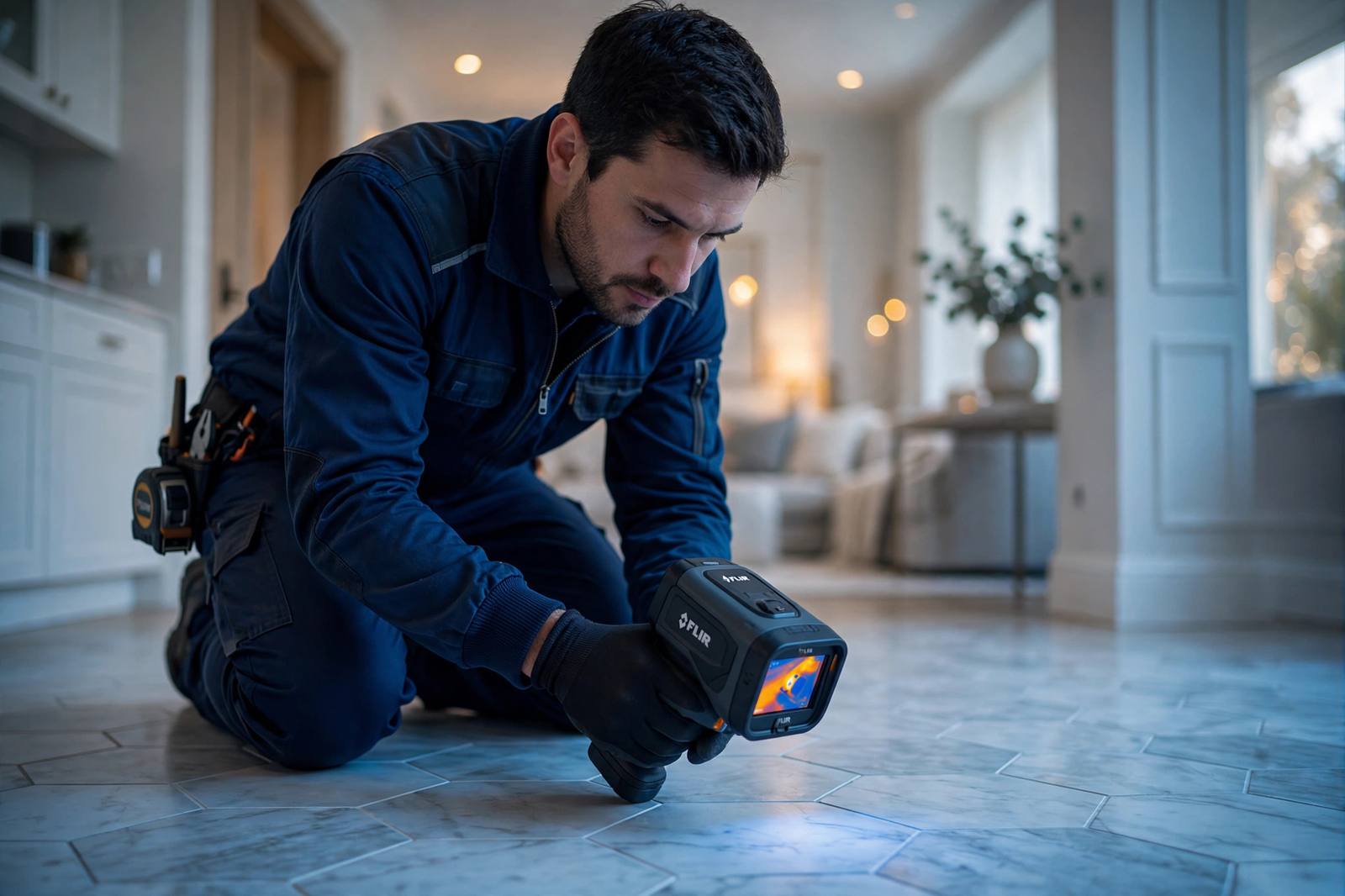
In a dry climate, water symptoms stand out — use that to your advantage. The most common first sign is a Colorado Springs Utilities bill that jumps without explanation; compare several months, since slow leaks ramp gradually. Feel for warm or hot spots on tile and hard floors — the tile so common in newer Springs builds transmits a hot-line leak's heat clearly. Listen at night for running or hissing water with everything off, and watch your water heater: if it cycles constantly, it may be feeding a leak rather than your showers. Pressure drops, especially on the hot side, and warm water arriving at cold taps both point underground. Visually, look for cracks in drywall or stucco that keep widening, flooring that tents or buckles, and baseboards pulling from walls. Outside, an inexplicably lush strip of lawn or a soggy patch that never dries in our arid air can trace a leaking line's path. And take mustiness seriously: Colorado's air is dry enough that a persistent earthy or mildew smell indoors almost always means sustained moisture somewhere — and the EPA's 24-to-48-hour mold window applies here just like anywhere. Any two of these signs together mean it's time for a professional test, not another billing cycle of hoping.
How We Detect Slab Leaks in Colorado Springs
Detection in the Springs is usually straightforward, and that's good news for your wallet. Most newer subdivisions are slab-on-grade with simple, documented pipe layouts, so we spend our time locating rather than mapping mysteries. A visit starts with your story and a meter check — Colorado Springs Utilities meters reveal even small continuous flows. We then isolate the system, pressure-testing hot and cold lines independently to identify the leaking side and narrow the search zone. Acoustic listening equipment picks up the high-frequency signature of pressurized water escaping through concrete, and because so many Springs homes have tile floors, thermal imaging cameras excel at revealing hot-line leaks as unmistakable heat blooms. For cold lines or ambiguous cases, we use tracer gas — an inert hydrogen-nitrogen blend introduced into the isolated line that escapes only at the breach and is detected at the surface with a sensitive sniffer. Electronic line locating maps the pipe's exact path so the repair plan avoids surprises. The process typically takes one to three hours, and you end up with the leak marked within inches, photos for your records (and your insurer), and written repair options with real numbers. No exploratory jackhammering, no demolition roulette. Most appointments are scheduled same-day, and you'll know exactly what you're dealing with before dinner.
Slab Leak Repair Options for Colorado Springs Homes
The right fix depends on the leak, the pipe, and the house around it. A <strong>spot repair</strong> — opening the slab at the marked location and replacing the failed section — is the economical answer for a single, first-time leak in an otherwise healthy system, and it's particularly clean in the Springs' single-story slab homes where access is simple. For leaks under two-story sections or finished spaces, an <strong>overhead reroute</strong> through the attic with new PEX abandons the failed line entirely — no slab demolition, no floor restoration, typically done in a day or two. It's a popular choice in Briargate and Falcon two-stories. <strong>Tunneling</strong> from outside reaches the leak from beneath without disturbing interior floors, but be aware that bentonite clay makes tunneling slower and costlier here — the soil swells and grips, demanding careful shoring and an experienced crew. It's the right call in specific situations, not a default. If your home has aging copper or 2000s-era brass PEX fittings with multiple failures, a <strong>partial or whole-house repipe</strong> stops the cycle of repeat leaks rather than chasing them one by one. Ask about epoxy lining only after a frank discussion of its track record — it's the right answer far less often than its marketing suggests. We'll price each viable option for your specific home and tell you which one we'd choose.
What Slab Leak Detection & Repair Costs in Colorado Springs
A full detection visit in Colorado Springs runs $175–$475, covering meter verification, pressure isolation, acoustic and thermal locating, and a written report with the leak pinpointed and options priced. That diagnostic fee is credited toward your repair when you proceed with us. Repair costs generally fall between $2,400 and $7,000. Straightforward spot repairs in accessible single-story slabs — the most common Springs scenario — typically land in the $2,400–$4,500 range. Overhead PEX reroutes usually run $2,800–$6,000 depending on the length of the run and the number of fixtures served. Costs climb toward the top of the range with tunneling in bentonite clay, difficult foothill-lot access, extensive tile restoration, or multiple leaks discovered during detection. Whole-house repipes for failing copper or fitting systems start higher but end the era of recurring emergency calls. Every quote is in writing before work begins — no vague allowances, no mid-job surprises. And a note on insurance: Colorado policies commonly cover sudden and accidental water damage while excluding the pipe repair itself and anything attributed to earth movement or settling, so document your meter readings, bills, and damage from day one and read your exclusions before filing. Financing options are available for larger repairs, so a big quote doesn't have to mean a delayed fix.
What to Do When You Suspect a Slab Leak
Move in this order. First, confirm: with all water off, check your Colorado Springs Utilities meter for continuous flow — even a small leak registers. Photograph the reading, avoid water use for an hour, and check again. Second, if you hear active running water or see spreading dampness, shut the main valve, usually near the meter or where the line enters the house; make sure everyone in the household knows where it is before you need it. Third, document relentlessly — meter photos, bill comparisons showing the spike, warm spots, cracks, damp areas. In Colorado, insurers examine slab-leak claims closely, especially where expansive soil is involved, and a day-one paper trail is your strongest asset. Fourth, look at your drainage while you wait for the appointment: extend downspouts away from the foundation, clear swales, and stop irrigating near the house — you won't fix the pipe this way, but you'll stop feeding the saturated soil around it. Fifth, don't break concrete yourself; blind demolition destroys evidence and turns a contained repair into a restoration project. Finally, get professional detection before anyone quotes a repair — a contractor pricing a fix without locating the leak is guessing with your money. We offer same-day visits across Colorado Springs, Fountain, Monument, and Falcon, and most appointments end with a marked leak and a written plan within hours.
Get a Pinpoint Diagnosis in Colorado Springs
No jackhammer guesswork. Thermal imaging + acoustic equipment finds your leak within inches.
☎ Call (877) 762-1902Colorado Springs Slab Leak FAQs
Are slab leaks common in newer areas like Briargate and Falcon?
Yes — newness is no shield. Briargate, the Powers corridor, and Falcon were built largely slab-on-grade over bentonite clay during fast growth cycles, and boom-era construction means rushed rough-ins, rocky backfill, and heavy irrigation saturating clay that barely drains. We regularly locate leaks in homes under 20 years old. A spiking utilities bill in a newer subdivision deserves the same suspicion as one in an older neighborhood.
Can hillside drainage cause a slab leak?
It can absolutely contribute. On hillside lots, surface runoff and poor grading drive water against and beneath the slab, keeping bentonite clay saturated and swollen against your foundation. Downspouts that dump beside the house, uphill neighbors' irrigation, and unmaintained drainage swales all feed the problem. Fixing grading and extending downspouts won't repair an already-failed pipe, but it protects the repair and the rest of your system.
What does slab leak detection and repair cost in Colorado Springs?
Detection runs $175–$475 for the full diagnostic visit. Repairs typically range from $2,400 to $7,000 — Colorado Springs jobs trend toward the upper end when tunneling is involved, because bentonite clay demands careful shoring, and when foothill-lot access complicates excavation. Straightforward spot repairs and attic reroutes in the newer subdivisions usually land in the lower half. Every job gets a written quote before work starts.
Does homeowners insurance cover slab leaks in Colorado?
Often partially. Colorado homeowners policies commonly cover sudden and accidental water damage — flooring, drywall, mold remediation — but typically exclude the cost of fixing the pipe itself, gradual wear, and damage blamed on earth movement or settling, a favorite exclusion in expansive-soil regions. Photograph your meter readings, bills, and any visible damage from day one, and review your policy's plumbing and earth-movement exclusions before you file.
How quickly can you find a slab leak in my home?
Usually same-day. Most detection visits take one to three hours: meter verification, hot/cold pressure isolation, acoustic listening, and thermal imaging. Slab-on-grade homes — which most of Colorado Springs' newer subdivisions are — are actually among the fastest to diagnose because the pipe layout is straightforward and accessible. You'll have a marked leak location and written repair options before we leave.
My home has PEX plumbing. Can it still get a slab leak?
Yes. PEX tubing itself resists corrosion and handles freeze expansion better than copper, but leaks still happen at brass fittings — including the dezincification-prone fittings used in some 2000s-era installs — and where tubing abrades against rocky backfill or concrete edges. Seasonal clay movement in the Springs stresses fittings and manifolds too. PEX lowers your risk; it doesn't eliminate it, so don't ignore the warning signs.
Nearby Cities
Keep Learning
Water Line vs Sewer Line Slab Leak: How to Tell
Is your slab leak on the water supply line or the sewer drain? Learn the symptoms, DIY meter tests, pro diagnostics, and repair co…
What Causes Slab Leaks? 7 Reasons Pipes Fail Under Concrete
What causes slab leaks? Corrosion, shifting soil, abrasion, high pressure & more. The 7 real reasons pipes fail under concrete — a…
Can a Slab Leak Cause Mold? Health Risks Explained
Can a slab leak cause mold? Yes — often hidden. Learn the EPA 24-48 hour growth window, health risks, warning signs, and the right…