Hot Spot on Your Floor? How to Tell If It's a Slab Leak
You walk across your kitchen tile barefoot and one patch feels strangely warm — not sun-warmed, not near an appliance, just a persistent hot spot that was not there before. That sensation is one of the most reliable early warnings of a slab leak, specifically a leak in a hot water supply line running beneath your concrete foundation. Pressurized hot water escaping through a pinhole in copper or PEX tubing heats the surrounding concrete, and that heat telegraphs straight up through tile, stone, or even carpet as a warm patch on the floor. But not every warm floor means a leak: radiant floor heating, afternoon sun through a window, a nearby water heater, or even a refrigerator condenser can create similar sensations. This guide shows you how to tell the difference with simple tests you can do today, what professionals do to confirm a hot water slab leak, what the repair options look like, and what it costs if you catch it early versus what happens if you ignore it.
What a Hot Spot Actually Means
Concrete is a good conductor of heat, which is why a hot water leak under a slab announces itself through the floor. Hot water lines typically run at 120 to 140 degrees, and when pressurized water escapes through a pinhole or failed joint, it continuously bathes the surrounding concrete and soil in hot water. That heat rises and spreads outward through the slab, creating a warm patch on the floor surface directly above and slightly around the leak. The spot often feels 10 to 20 degrees warmer than the surrounding floor — noticeable in bare feet, and sometimes detectable with an infrared thermometer reading 85 to 100 degrees on the surface while the rest of the floor sits in the 70s. Unlike a sun-warmed patch, a leak-driven hot spot does not move or fade: it is warm at midnight, warm in the morning, warm regardless of weather, because the leak never stops. The edges of the warm area are usually gradual rather than sharp. Tile and stone floors transmit the sensation most clearly, but homeowners with carpet or laminate report it too — sometimes as a room that always feels warmer, or carpet that seems damp underneath. If you have found such a spot, you have already done the hardest part: noticing it. Most slab leaks are caught far later, after the water bill spikes or the floor cracks. One useful habit: once you have found the spot, outline it lightly with painter's tape and date it. If the warm area grows over the coming days, that expansion is additional evidence of an active leak — and the tape gives the detection technician a head start on day one.
Why Hot Water Lines Fail Under Slabs
Hot water lines fail under slabs for specific, well-understood reasons. Copper tubing — the standard in homes built from the 1960s through the early 2000s — develops pinhole leaks from a combination of water chemistry, soil conditions, and age. Aggressive or acidic water corrodes copper from the inside; alkaline or mineral-heavy soil corrodes it from the outside; and in regions with hard water, mineral buildup creates turbulence that accelerates wear. A copper hot water line under a slab typically lasts 20 to 50 years, so homes built in the 70s, 80s, and 90s are now squarely in the failure window. Hot lines fail before cold lines because heat accelerates corrosion chemistry and thermal expansion stresses joints with every heating cycle. Concrete itself can be the enemy: if the pipe was laid directly against concrete without a protective sleeve, the alkalinity of the concrete attacks copper over decades. Foundation movement — from expansive clay soil swelling and shrinking — flexes rigid copper until it cracks. PEX tubing, common in newer construction, resists corrosion but can fail at fittings or from abrasion where it rubs against rebar or rough concrete. Knowing your home's age and pipe material tells you a lot: a 1985 home on a slab with original copper and a new hot spot is a textbook case. Water quality reports from your local utility can add another clue — ask for the pH and hardness figures. Water with pH below 7 is acidic and aggressive toward copper, while very hard water accelerates scaling and turbulence. Either extreme shortens the life of under-slab copper.
Ruling Out the Innocent Explanations
Before calling anyone, rule out the innocent explanations — it takes ten minutes and saves an unnecessary service call. First, check for radiant floor heating: look at your thermostat for a floor-heat zone, or check whether the warmth covers a whole room evenly (heating) versus one irregular patch (leak). Second, consider sunlight: does the warm patch align with a window's afternoon sun path? Close the blinds for a day and recheck — sun patches fade, leak spots do not. Third, look for heat sources below or nearby: a water heater in a closet, a furnace duct, or even a refrigerator with a condenser coil can warm adjacent flooring. Fourth, check the time pattern: walk the floor late at night and early in the morning. A leak-driven hot spot is constant; environmental warmth fluctuates. Fifth, use the back of your hand or an inexpensive infrared thermometer (under $30 at any hardware store) to map the warm area's boundaries — a leak creates a roughly circular warm zone, often 2 to 4 feet across, while heating systems and sun create larger, more uniform patterns. If the spot survives all these checks — constant, localized, unexplained — you have a legitimate suspect and it is time for the water meter test and a professional call. A quick cross-check: compare the suspect spot against the same location in a neighboring room with identical flooring. If the warmth is truly localized to one patch while equivalent areas stay cool, environmental causes become very unlikely. Document the comparison with thermometer readings — it strengthens your case when you call.
DIY Tests That Confirm Your Suspicion
Once you have a suspicious hot spot, two DIY tests add real evidence. The water meter test: turn off every fixture and appliance, then watch the meter's flow indicator. If it moves with nothing running, water is escaping somewhere — and combined with a hot spot, that is a strong case for a hot water line leak. For a subtler check, run the hot water meter test: turn off the cold water supply valve to the water heater (usually a valve on the cold inlet pipe), then check the meter. If the meter was moving and now stops, the leak is on the hot water side — confirming your hot spot theory. The second useful test is the water heater cycle check: do not use any hot water for several hours, then listen to your water heater. If the burner or elements kick on repeatedly with zero hot water use, the tank is reheating water that is leaking away under your slab. You can also compare gas or electric bills: a hot water leak forces the heater to work overtime, so an unexplained bump in energy costs alongside the hot spot is corroborating evidence. Document everything — photos of the thermometer readings, meter observations, bill comparisons. This file becomes valuable if you file an insurance claim, and it helps the leak detection tech work faster. If you can safely access your water heater, note the model and age as well — a heater over 12 years old working overtime against a leak is living on borrowed time, and bundling a heater replacement with the leak repair sometimes saves on labor.
How Professionals Pinpoint the Leak
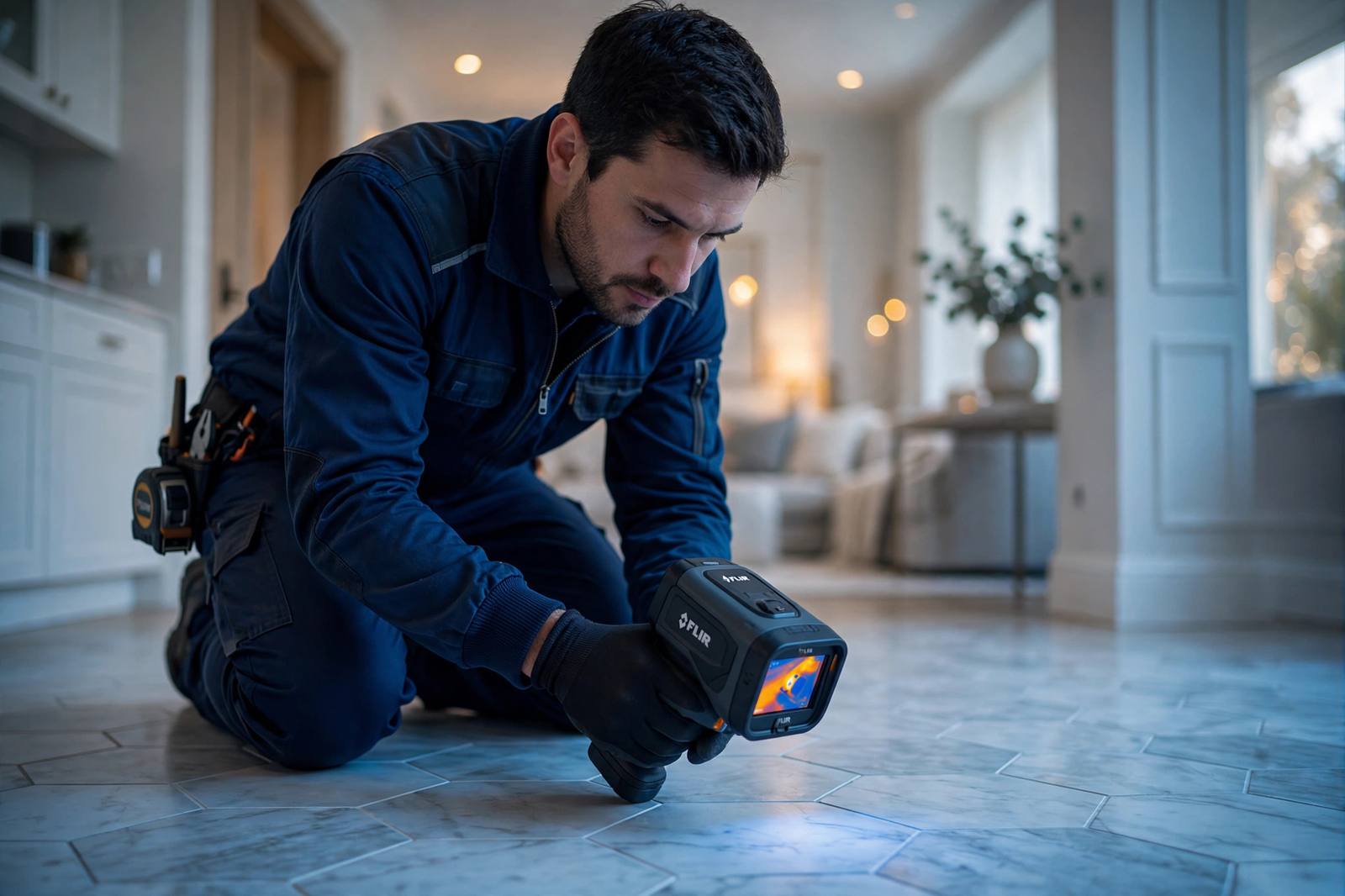
A leak detection specialist will confirm a hot water slab leak with tools built for exactly this job, and the process is non-destructive. Thermal imaging is the star: an infrared camera visualizes the warm plume spreading through the slab, often showing the leak location within a foot or two. The tech will scan the floor systematically, and the hot spot you found becomes the starting point — expect them to map a larger warm zone than you felt, since the camera sees what feet cannot. Acoustic listening equipment comes next: pressurized water escaping through a pinhole produces a distinct high-frequency hiss, and electronic ground microphones filter out background noise to isolate it. Combining thermal and acoustic results gives a confident pinpoint. The tech may also run an isolation test, valving off the hot water system and watching a pressure gauge for drop, which proves the leak is on the hot side before anyone touches concrete. A full electronic detection visit typically costs $150 to $600 and takes one to two hours. Be wary of any company that wants to start breaking concrete based on your description alone — proper pinpointing is the difference between a 12-inch square opening and a demolished room. Ask the tech to mark the spot and show you the thermal image; reputable companies do this as a matter of course. Keep the thermal images and the written detection report in your home file. If the leak turns out to be part of a pattern — or if you sell the home later — that professional documentation proves exactly what was found and where.
Repair Options for a Hot Water Slab Leak
Once located, a hot water line leak under a slab has three main repair paths, each with real trade-offs. A spot repair opens the slab at the pinpointed location — usually a square foot or two — and replaces the damaged pipe section with new copper or PEX, then patches the concrete. It is the cheapest option at $500 to $1,500 plus flooring restoration, and it makes sense when the rest of the system is young and healthy. The downside: the next pinhole could be a foot away, and in aging copper systems, spot repairs sometimes become a recurring series. A reroute abandons the under-slab line entirely and runs new PEX tubing through walls, ceilings, or the attic to the affected fixtures. At $2,000 to $5,000 for a whole-house reroute, it costs more upfront but permanently removes the failure-prone pipe from under the slab — the preferred fix for homes with aging copper. The third option, epoxy pipe lining, coats the inside of the existing pipe without breaking concrete, at roughly $80 to $250 per linear foot; it works well for accessible runs but is not suitable for every configuration. Your choice should factor in pipe age, how many leaks you have had, and how long you plan to stay in the home. For a single leak in a 15-year-old system, spot repair is reasonable; for the third leak in 30-year-old copper, reroute is the smarter money. Whichever route you choose, confirm the plan for concrete and flooring restoration in the written quote. The plumbing fix is only half the job — patching the slab, matching the flooring, and repainting can add $500 to $2,000, and you want to know who handles it before work begins.
What Early Detection Saves You
Catching a hot water slab leak at the hot-spot stage is the best-case scenario financially. Detection costs $150 to $600, a spot repair $500 to $1,500, and even a full reroute at $2,000 to $5,000 resolves the problem permanently. Compare that with the cost of waiting: a hot water leak wastes water continuously — often 50 to 200 gallons a day for a pinhole — which shows up on both water and energy bills month after month. Worse, the constant hot moisture under the slab erodes supporting soil, and once the slab loses support it can crack, heave, or settle — foundation repairs start at $5,000 and climb past $15,000. Persistent moisture also invites mold within the EPA's 24 to 48 hour window for mold growth on damp materials, and flooring over the leak (wood, laminate, carpet) will eventually warp, buckle, or rot. Insurance may cover sudden and accidental water damage from the leak, but most policies exclude damage from leaks that continued over a long period — another reason prompt action protects you financially. If you have found a hot spot, you have caught the problem early. A same-week detection appointment is a few hundred dollars; the alternative is measured in thousands. That math should make the decision easy. One last consideration: tell your homeowner's insurance about the situation early, even before you have a full diagnosis. Policies generally cover sudden and accidental water damage, and early notification protects your claim. Just be factual about the timeline — insurers distinguish between damage you reported promptly and problems that sat unaddressed.
Talk to a Slab Leak Pro
Reading is good. A pinpoint diagnosis is better — thermal imaging and acoustic equipment find your leak within inches.
☎ Call (877) 762-1902Frequently Asked Questions
Is a warm spot on my floor always a slab leak?
Not necessarily, but it is one of the most common causes — especially a hot water supply line leak under the slab. Rule out radiant heating, sunlight, and appliances first with the tests in this guide. If the spot persists with heating off and blinds closed, call a leak detection specialist.
How hot is a typical slab leak hot spot?
Most slab-leak hot spots feel noticeably warm to bare feet — often 10 to 20 degrees warmer than the surrounding floor — and stay warm around the clock. A spot that is only mildly warm or comes and goes with the weather is more likely environmental.
Can I just ignore a hot spot if my water bill looks normal?
It is risky. A hot water line leak runs continuously, wasting water and eroding soil under your slab. What starts as a warm tile can become foundation movement, mold, and a much larger repair bill. Get it checked within days, not months.
Will a hot water slab leak always show up on my water bill?
Often yes. A pinhole leak may only lose a few dozen gallons a day — not enough to spike the bill dramatically at first — but enough to warm the floor and damage the slab over time. Do not rely on the bill alone; the meter test is more sensitive.
Do I have to tear up my whole floor to fix it?
Not always. Electronic detection (thermal imaging plus acoustic listening) can often pinpoint the leak within a foot or two, allowing a small, targeted opening. Rerouting the line through the attic or walls avoids the slab entirely. Full floor demolition is a last resort, not the default.
Can a hot spot come and go?
A true leak-driven hot spot does not come and go — the leak runs constantly, so the warmth is steady around the clock. A spot that fades at night or in cool weather is more likely sun exposure, heating cycles, or an appliance. Consistency is the key differentiator: constant warmth points to a leak, intermittent warmth points elsewhere.
Related Guides
7 Signs of a Slab Leak Every Homeowner Should Know
Spot a slab leak before it destroys your foundation. The 7 warning signs — high water bills, hot spots, cracks — plus what to do n…
How Plumbers Find Slab Leaks: 5 Detection Methods Explained
How do plumbers find slab leaks? Acoustic listening, thermal imaging, tracer gas, pressure tests and cameras explained — methods, …
Copper Pinhole Leaks Under Slabs: Repair or Repipe?
Copper pinhole leaks under your slab: what causes pitting corrosion, repair vs repipe costs, and how to decide. Real numbers for f…