Slab Leak Detection & Repair in Austin, TX
Austin's explosive growth built hundreds of thousands of slab-on-grade homes in just a few decades, and that speed left a legacy of plumbing problems. Tract subdivisions from the 1980s through the 2000s went up fast across Steiner Ranch, Circle C, Wells Branch, and the suburbs, and our technicians regularly find kinked PEX, unbedded lines, and rocks in trenches beneath slabs that are barely twenty years old. Meanwhile, central Austin's older housing stock in Hyde Park, Brentwood, and Tarrytown still runs original copper now deep in its failure window, stressed by the Taylor clay soils that swell and shrink with Central Texas weather. We provide same-day slab leak detection across the Austin metro with acoustic listening, thermal imaging, and tracer gas, pinpointing leaks within inches before any concrete is touched. From downtown condos to Hill Country-edge estates, every visit ends with a written diagnosis, photo documentation, and flat-rate repair options. Whether your home is a 1990s tract build or a 1960s central Austin classic, a spiking water bill or a warm patch on the floor deserves same-day attention.
Neighborhoods We Serve in Austin
Hyde Park, Tarrytown, Westlake, Mueller, Zilker, Brentwood, Circle C Ranch, Steiner Ranch, Wells Branch, Crestview — and every ZIP code in between.
Why Austin Homes Get Slab Leaks
Much of Austin sits on Taylor clay, locally notorious for extreme expansion and contraction, layered over Edwards limestone along the western Hill Country edge. The clay swells with Central Texas storms and shrinks in the long dry season, heaving slabs twice a year and fatiguing buried joints. Near the limestone edge, rocky trenches sometimes left pipe in contact with sharp stone, creating abrasion failures, while hard Central Texas water pits aging copper from the inside.
Two Eras of Austin Slab Leaks: Boom Builds and Older Homes
Austin's slab leak story has two distinct chapters, and your home falls into one of them. Chapter one is the boom era. Between 1980 and 2010, the metro added subdivisions at a blistering pace, and speed was the enemy of quality. Our technicians pull the same defects from under these slabs again and again: PEX lines kinked during rough-in, copper laid directly on rocky trench bottoms without sand bedding, and backfill containing limestone chunks that abrade pipe walls with every soil movement. These are installation failures, not age failures, which is why we find them in homes barely fifteen years old in Pflugerville, Cedar Park, and Manor. Chapter two is the older core. Hyde Park, Brentwood, Crestview, and Tarrytown hold 1950s through 1970s homes with original copper now fifty to seventy years old, running beneath slabs on Taylor clay, one of the most expansive soils in Central Texas. Here the mechanism is classic: seasonal swell and shrink flexes joints, hard water pits the copper from inside, and pinholes open. The Hill Country edge adds a wrinkle: thin soils over limestone where trenches were blasted or cut through rock, sometimes leaving pipe in direct contact with sharp stone. Either way, Austin homeowners should know their chapter. Boom-era tract home? Suspect installation defects. Pre-1980 central home? Suspect age, corrosion, and clay. Both are fixable, but they fail differently and we diagnose accordingly.
Slab Leak Symptoms in Austin Homes
The warning signs read the same across the metro, but the context differs by neighborhood. A water bill that jumps without explanation is the universal first flag; Austin Water's online usage portal makes it easy to spot abnormal spikes day by day. Warm spots on tile or wood point to hot-line failures, common in both aging copper systems and kinked PEX runs. Listen for hissing or running water in quiet hours, and look for tile cracking, laminate buckling, or carpet dampness along baseboards. A water heater cycling far beyond your usage pattern is heating water that is escaping underground. Persistent musty odors mean moisture is wicking into wall cavities. In boom-era suburbs, watch for premature failures that seem out of place for the home's age: a 2005 home with a slab leak almost always has an installation defect, and finding one kink often means others are waiting. In central Austin, companion foundation symptoms matter: doors sticking after dry spells and hairline brick cracks that widen, because Taylor clay moves foundations and leaking water accelerates it. An unusually green lawn strip during a dry spell can mark a supply leak feeding the grass. When the bill spikes and any physical sign appears, same-day detection beats another month of monitoring every time.
How We Locate Slab Leaks in Austin
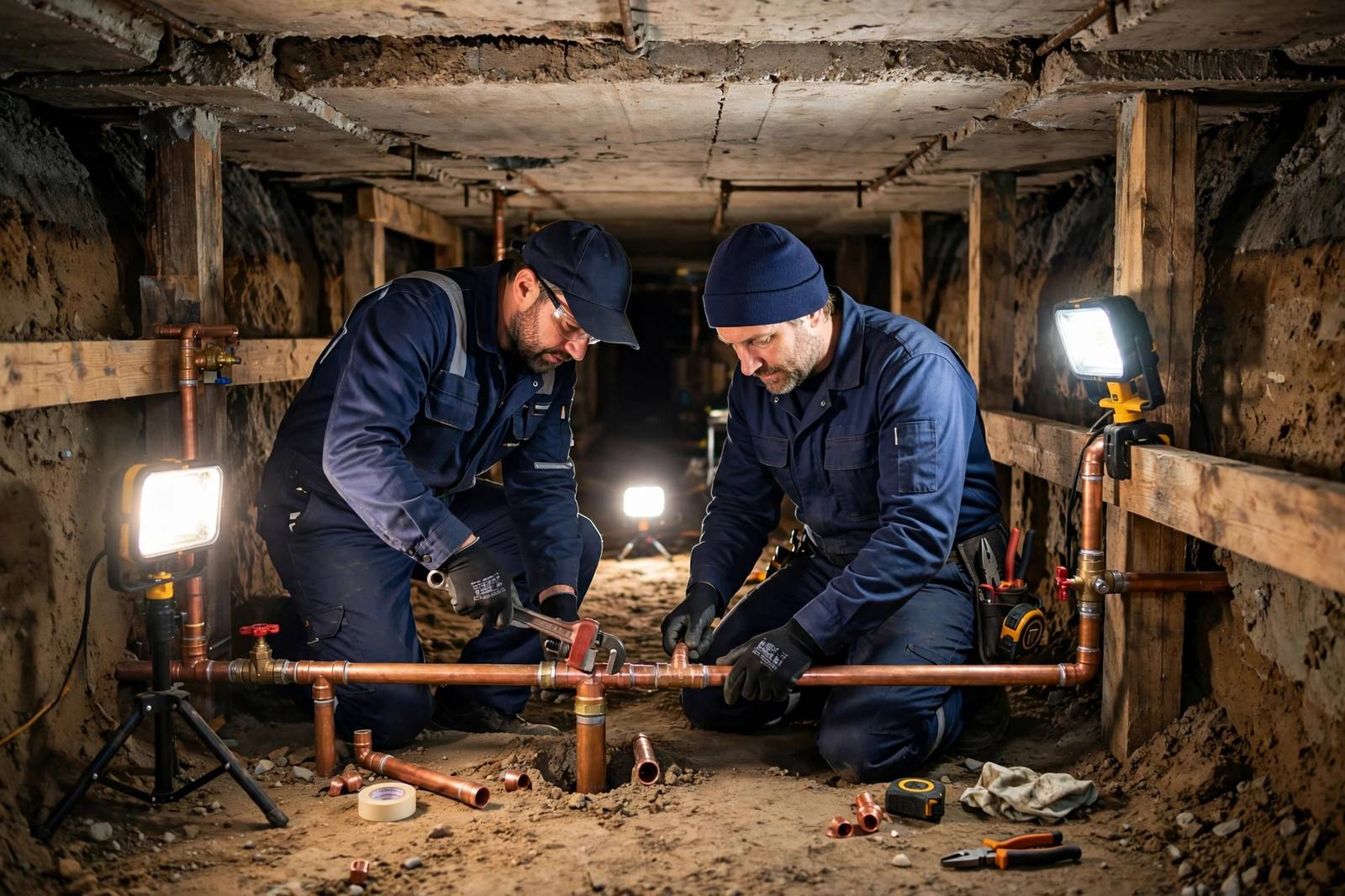
Our Austin technicians run a strict no-guesswork protocol. It starts at the water meter with the entire house shut down: fixtures, ice maker, irrigation. A moving dial proves a pressurized leak, and closing the water heater supply valve reveals whether it is hot-side or cold-side, halving the search area immediately. Acoustic listening comes next. Ground microphones detect the high-frequency hiss of water escaping under pressure, and experienced technicians separate a leak's signature from background noise. Thermal imaging scans floors for heat blooms from hot-line failures, highly effective on the tile and stained concrete floors common in Austin homes. For ambiguous cases, tracer gas delivers certainty: the line is drained, charged with a safe hydrogen-nitrogen blend, and a sniffer finds the exact escape point, often within inches, even under post-tension slabs common in newer construction. Segment pressure tests then confirm the diagnosis before any repair is proposed. The visit takes one to two hours and produces a written report with the marked location, thermal images, and a flat repair quote. That documentation carries weight with insurers, builders honoring warranties on newer homes, and buyers during resale. No concrete is discussed until the location is proven.
Slab Leak Repair Options Across Austin
Austin homeowners typically choose from four repair strategies. Spot repair opens the slab at the pinpointed location, replaces the failed section, and patches the concrete. It fits a single isolated defect, like one kinked PEX run in an otherwise sound young system. Tunneling goes underneath: technicians hand-dig from outside the foundation and repair from below, preserving floors. In Westlake, Tarrytown, and Mueller homes with premium flooring, tunneling frequently wins on total project cost despite higher labor. Rerouting abandons the failing under-slab line and runs new PEX through walls and attic, the right answer when failures repeat in different spots, whether from systemic corrosion in older copper or multiple installation defects in a tract home. Whole-house repiping replaces every supply line and is the definitive fix for pre-1980 homes with original copper or boom-era homes with widespread rough-in defects. Our technicians lay out every viable option with pricing, expected lifespan, and disruption, because the best choice depends on your home's era and failure history. All work is permitted through the City of Austin or the county, pressure-tested, and warranted in writing, with restoration coordinated under one roof.
Austin Slab Leak Costs: What to Expect
Austin detection visits with professional acoustic, thermal, and tracer gas equipment run $175 to $475, normally credited toward the repair. Spot repairs on a pinpointed leak typically cost $2,400 to $4,500 including breakout, pipe replacement, backfill, and slab patching. Tunneling ranges from $4,500 to $7,500 for the excavation labor, but protects flooring often worth far more. A hot-line reroute through the attic generally lands between $2,800 and $5,500 depending on run length and fixture count. Whole-house repipes for a typical 2,000-square-foot home run $7,500 to $15,000. Austin-specific cost drivers include post-tension slabs, which are common in newer construction and require careful scanning before any cutting, and limited access in dense central neighborhoods. Be wary of quotes far below these ranges: no permit, no pressure test, and buried compression fittings are the usual shortcuts, and they fail. Our quotes itemize labor, materials, permit fees, and restoration as separate lines for honest comparison, and financing is available for repipes and larger projects. For newer homes, check builder warranty coverage first; plumbing defects inside the warranty window can shift costs to the builder, and our documentation supports those claims.
First Steps for Austin Homeowners
Verify the leak yourself before calling. Shut off every fixture, the ice maker, and the irrigation, then watch the water meter for fifteen minutes. Movement means pressurized water is escaping. Close the water heater supply and recheck; a stopped meter points to the hot side. Photograph the meter, any damp spots, cracked tile, or warm areas, because documentation accelerates insurance claims and supports builder warranty claims on newer homes. If water is actively surfacing, shut the main valve to stop damage and billing. Then call for same-day detection rather than waiting. In Austin's expansive clay, leaking water erodes soil support and the slab settles, which stresses more joints and multiplies failures. This is doubly true for boom-era homes where one installation defect often predicts others. Never approve jackhammering on a guess. A proper detection visit takes about two hours and costs a few hundred dollars; a misplaced slab opening costs thousands and fixes nothing. When our technician arrives, expect a confirmed location, thermal images, and a flat quote before concrete work enters the conversation. Most repairs schedule within days and complete in one to three days, with the full price approved by you before we start.
Get a Pinpoint Diagnosis in Austin
No jackhammer guesswork. Thermal imaging + acoustic equipment finds your leak within inches.
☎ Call (877) 762-1902Austin Slab Leak FAQs
How much does slab leak detection cost in Austin?
Austin detection visits run $175 to $475 with acoustic, thermal, and tracer gas equipment. The appointment takes one to two hours and ends with a marked location, thermal images, and a flat repair quote. The fee is credited toward the repair when you proceed with our team.
Do you offer same-day service in Austin?
Same-day service is our standard across the Austin metro, including Round Rock, Cedar Park, and Pflugerville. Detection visits are typically scheduled within hours, and most repairs begin within a few days of the diagnosis.
Which Austin neighborhoods get the most slab leaks?
The boom-era subdivisions of the 1980s through early 2000s in areas like Steiner Ranch, Circle C, Wells Branch, and parts of Cedar Park and Pflugerville see the most failures, along with older central Austin homes in Hyde Park and Brentwood running original copper. Fast tract construction produced kinked PEX and poorly bedded lines, while older homes face corrosion and clay movement.
Will insurance cover a slab leak in a newer Austin home?
Texas policies typically cover resulting damage, like ruined flooring, but exclude the pipe repair as wear and tear. New-construction builder warranties sometimes cover plumbing defects for a limited period, so check your warranty documents if the home is under ten years old.
How long does the repair take in Austin?
A spot repair is usually done in one day. Tunneling takes two to three days, and reroutes or whole-house repipes take two to five days. Austin and Travis County permit inspections are coordinated as part of the job.
Is the work warrantied in Austin?
Yes. Spot repairs carry a multi-year workmanship warranty, and reroutes and repipes include extended coverage on labor and materials. All work is permitted, pressure-tested, and documented with photos.
Nearby Cities
Slab leak pros nearbyCorpus Christi
Slab leak pros nearbyDallas
Slab leak pros nearbyEl Paso
Slab leak pros nearbyFort Worth
Slab leak pros nearbyFrisco
Slab leak pros nearby
Keep Learning
How Long Does Slab Leak Repair Take? Realistic Timelines
How long does slab leak repair take? Spot repairs: 1 day. Reroutes: 1-2 days. Tunneling: 2-4 days. Realistic timelines, costs, and…
How Plumbers Find Slab Leaks: 5 Detection Methods Explained
How do plumbers find slab leaks? Acoustic listening, thermal imaging, tracer gas, pressure tests and cameras explained — methods, …
Selling a House With a Slab Leak: Disclosure & Value
Selling a house with a slab leak? Learn disclosure rules, how leaks affect home value, repair-vs-as-is math, and the paperwork tha…