Slab Leak Detection & Repair in Plano, TX
Plano might be the slab leak capital of North Texas, and local soil scientists would not be surprised. The city sits on some of the most expansive clay in the metroplex, the kind that can lift slab edges inches in a wet spring and drop them just as far in a dry August. Layer that onto the massive 1980s and 1990s building boom that filled Legacy, Willow Bend, Deerfield, and Kings Ridge with copper-plumbed slab homes, and you get thousands of properties now entering peak failure age at the same time. Our technicians provide same-day slab leak detection throughout Plano using acoustic listening, thermal imaging, and tracer gas, pinpointing leaks within inches before any concrete is touched. In a city where homes routinely carry tile, hardwood, and stone flooring worth tens of thousands, our tunneling option, which repairs from below without touching your floors, is especially popular. Every visit ends with a marked location, photo documentation, and flat-rate options matched to your home's age and finishes. A spiking water bill or a warm spot on the tile is your early warning, and in Plano's clay, early action saves serious money.
Neighborhoods We Serve in Plano
Legacy West, Willow Bend, Deerfield, Kings Ridge, Old Town Plano, Ridgeview, Gleneagles, Park Forest, Timber Brook, Los Rios — and every ZIP code in between.
Why Plano Homes Get Slab Leaks
Plano sits on highly plastic clays along the Austin chalk escarpment, ranked among the most expansive soils in North Texas. Seasonal moisture swings can move the ground inches differentially under a single slab, lifting one side while the other settles. That relentless movement fatigues copper joints and work-hardens pipe walls, while uneven irrigation and foundation watering create the moisture imbalances that tilt slabs and shear connections.
Why Plano's Clay Makes Slab Leaks Inevitable
Plano's reputation among foundation and plumbing contractors is no accident; it is geology. The city sits on the Austin chalk escarpment's eastern clays, a band of highly plastic soil that engineers rank among the most expansive in Texas. In practical terms, that means the ground under your slab can move inches between a wet March and a dry August, and it does so unevenly, lifting one corner while another drops. Buried copper endures that differential movement at every joint, and after decades the metal fatigues. Plano's building timeline concentrated the risk. The 1980s and 1990s boom built tens of thousands of slab-on-grade homes in a rush, most plumbed with copper run directly beneath the slab. That copper is now thirty-five to forty-five years old, which is precisely when pinhole failures accelerate, and the aggressive clay has been working it the entire time. Irrigation habits add fuel. Plano's large lots and foundation-watering culture keep some zones saturated while others bake, creating exactly the uneven moisture profiles that tilt slabs. Even the city's affluence plays a role: large footprints mean long under-slab pipe runs with more joints to fail, and high-end finishes mean every repair decision must weigh flooring value. If your Plano home was built between 1978 and 1998 with original plumbing, consider its under-slab lines a maintenance item, not a lifetime component.
Tunneling and Repair Options That Protect Plano Flooring
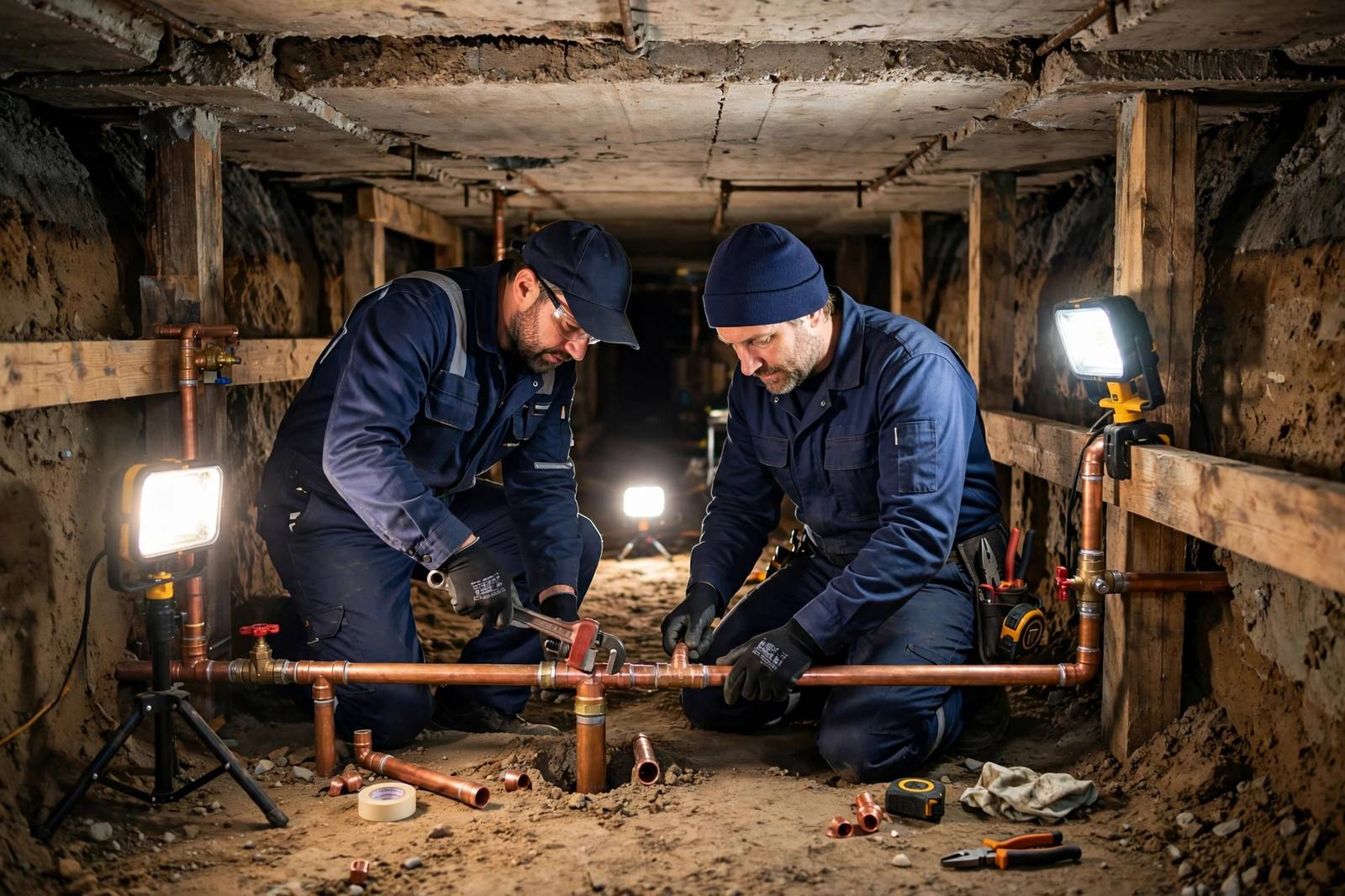
Because Plano homes carry expensive finishes, tunneling deserves first mention. Instead of breaking through your tile or hardwood, technicians hand-excavate a tunnel beneath the foundation from outside, repair or replace the line from below, then backfill and compact. Your floors are never touched. In Legacy West, Willow Bend, and Stonebriar-adjacent neighborhoods where flooring replacement alone can exceed $15,000, tunneling's $4,800 to $7,800 price frequently beats the true cost of a breakout repair. Spot repair through the slab remains the economical choice for a single isolated failure under carpet, garage, or utility areas, typically $2,500 to $4,500 all-in. Rerouting abandons the failing under-slab copper and runs new PEX through walls and attic, the smart answer when pinholes keep appearing in new locations across a forty-year-old system. Whole-house repiping replaces every supply line and is the permanent solution for 1980s homes where the clay and water chemistry have compromised the entire network; at $8,000 to $16,000 for larger Plano homes, it ends the cycle of repeat openings. Our technicians quote every viable path with full restoration costs included, because in Plano the flooring math often decides. All work is permitted through the City of Plano, pressure-tested, and warranted in writing.
Pinpoint Detection Before Any Concrete Work in Plano
Our Plano detection visits are engineered for certainty, because breaking the wrong spot in a home with $20,000 of tile is a costly mistake. The process starts at the water meter with everything shut off. A moving dial proves a pressurized leak, and isolating the water heater tells us whether it is hot-side or cold-side, halving the search immediately. Acoustic listening follows with sensitive ground microphones that detect the high-frequency hiss of escaping water through slab and tile. Thermal imaging cameras then map heat blooms from hot-line failures, fast and visual. For faint signals or thick post-tension slabs, tracer gas pinpoints within inches: the line is drained, charged with a safe hydrogen-nitrogen mix, and a sniffer finds the exact escape point. Segment pressure tests confirm the diagnosis before any repair discussion. The visit takes one to two hours and produces a written report with the marked location, thermal images, and a flat repair quote. That paper trail is especially valuable in Plano, where high-value flooring claims, home warranty disputes, and resale disclosures all demand proof of exactly what failed and where. No concrete is touched until the location is proven twice.
Slab Leak Warning Signs in Plano Homes
Plano homeowners should watch for the standard signals with an eye on local conditions. A water bill that jumps without explanation is the earliest flag; Plano's tiered rates make overuse expensive fast, so spikes hurt twice. Warm spots on tile or hardwood indicate hot-line failures, common in large homes with long runs to distant primary suites. Hissing sounds in quiet hours, tile that cracks or tents, hardwood cupping at the seams, and damp carpet along baseboards all warrant prompt checks. A water heater cycling beyond your usage is heating water that is leaking away. Musty odors that persist after cleaning mean moisture is wicking into walls. Outdoors, a lush lawn strip during the dry months can mark a supply leak feeding it from below. In Plano, pair plumbing vigilance with foundation vigilance: doors sticking after dry spells, hairline brick cracks widening, and gaps at window frames can share a root cause with slab leaks, because leaking water erodes the same expansive clay that supports the foundation, and foundation movement then stresses more joints. It is a feedback loop, and early detection breaks it. When the bill spikes and any physical sign appears, same-day detection is the economical move.
What Slab Leak Detection and Repair Costs in Plano
Plano detection visits with professional equipment run $175 to $475, credited toward the repair. Spot repairs on a pinpointed leak typically cost $2,500 to $4,500 including breakout, pipe work, backfill, and slab patching. Tunneling ranges from $4,800 to $7,800 for the excavation labor; compare that against flooring replacement quotes before deciding, because in most Plano homes tunneling wins on total cost. Hot-line reroutes through the attic generally land between $2,800 and $5,800 given the long runs in larger homes. Whole-house repipes run $8,000 to $16,000 depending on size and fixture count. Plano-specific cost drivers include post-tension slabs in 1990s builds requiring pre-cut scanning, large footprints with long pipe runs, and high-end finish restoration. Be skeptical of bids far below these bands; skipped permits, untested joints, and buried compression fittings are the usual shortcuts. Our quotes itemize labor, materials, permit fees, and restoration as separate lines, and financing is available for repipes and tunneling projects. Remember the real comparison: a $3,000 breakout that destroys $12,000 of hardwood is a $15,000 project wearing a cheap disguise. Remember that these ranges cover the most common scenarios — unusual layouts, post-tension slabs, or leaks tucked beneath additions can shift the final number, which is why a proper on-site diagnosis with acoustic and thermal equipment matters more than any phone estimate. A reputable local pro will pinpoint the leak first, then quote the repair with the location and method spelled out in writing.
First Steps for Plano Homeowners
Verify the leak yourself first. Shut off all fixtures, ice makers, and irrigation, then watch the water meter for fifteen minutes. A moving dial means pressurized water is escaping. Close the water heater supply valve and recheck; a stopped meter points to the hot side. Photograph the meter, any damp areas, and damaged flooring, because in Plano the documentation supports both insurance claims and the flooring restoration scope. If water is actively surfacing, shut the main valve to stop damage and billing. Then call for same-day detection. In Plano's clay, delay is expensive twice over: leaking water erodes soil support, and the resulting slab movement can crack the very tile and stone you are trying to protect, while also stressing additional joints into failure. Never approve jackhammering on a guess, especially with premium floors at stake. A proper detection visit takes about two hours and costs a few hundred dollars; a misplaced opening in hardwood or stone costs many thousands. When our technician arrives, expect a confirmed location, thermal images, and a flat quote with full restoration costs before any concrete discussion. Most repairs schedule within days and finish in one to three days, with the total price approved by you upfront.
Get a Pinpoint Diagnosis in Plano
No jackhammer guesswork. Thermal imaging + acoustic equipment finds your leak within inches.
☎ Call (877) 762-1902Plano Slab Leak FAQs
How much does slab leak detection cost in Plano?
Plano detection visits run $175 to $475 with acoustic, thermal, and tracer gas equipment. The appointment takes one to two hours and ends with a marked leak location, thermal images, and a flat repair quote. The fee is credited toward the repair when you proceed with our team.
Why does Plano have so many slab leak and foundation problems?
Plano is built on some of the most expansive clay in North Texas, and the city's 1980s and 1990s boom put thousands of copper-plumbed slab homes on it. That combination of aggressive soil movement and forty-year-old copper is why foundation and plumbing contractors alike stay busy here.
Will homeowners insurance cover a slab leak in Plano?
Generally yes for resulting damage like ruined flooring, while the pipe repair itself is usually excluded as wear and tear. In higher-value Plano homes, documenting damage thoroughly matters because flooring and finish claims can be substantial.
Is tunneling worth it in Plano?
Tunneling is the most popular choice in Plano because it preserves tile, hardwood, and stone without a single cut from above. It costs more in labor, typically $4,800 to $7,800, but in homes where flooring replacement would run five figures, it is usually the economical total project.
How long does slab leak repair take in Plano?
A spot repair is typically done in one day. Tunneling takes two to three days, and reroutes or repipes run two to five days. Plano permit inspections are coordinated as part of the project schedule.
Do Plano slab leak repairs come with a warranty?
Yes. Every repair includes a written workmanship warranty, with extended coverage on tunneling, reroutes, and repipes. Work is permitted, pressure-tested, and documented with photos.
Nearby Cities
Keep Learning
Water Line vs Sewer Line Slab Leak: How to Tell
Is your slab leak on the water supply line or the sewer drain? Learn the symptoms, DIY meter tests, pro diagnostics, and repair co…
What Causes Slab Leaks? 7 Reasons Pipes Fail Under Concrete
What causes slab leaks? Corrosion, shifting soil, abrasion, high pressure & more. The 7 real reasons pipes fail under concrete — a…
Can a Slab Leak Cause Mold? Health Risks Explained
Can a slab leak cause mold? Yes — often hidden. Learn the EPA 24-48 hour growth window, health risks, warning signs, and the right…