Slab Leak Detection & Repair in San Jose, CA
San Jose's slab leaks are a slow-motion collision of geology and the building boom. The valley floor is lined with adobe clay — some of California's most expansive soil — which swells with winter rain and shrinks through months of dry heat, rocking slabs year after year. Under those slabs, in the ranch tracts of Blossom Hill, Almaden, Cambrian Park, and Evergreen, copper lines from the 1960s through 1980s carry a 40-to-60-year design life. That lifespan is expiring across entire neighborhoods at once. Symptoms start quietly: a hot stripe across kitchen tile in Willow Glen, a water bill climbing in Berryessa for no reason, the faint rush of water behind a wall at night. Our technicians find these leaks electronically — pressure isolation, acoustic sensors, infrared imaging, tracer gas — and mark the exact break within inches. Most repairs finish the same day or the next, usually by rerouting the line overhead instead of breaking concrete. If your San Jose home is showing the signs, early detection is the difference between a plumbing repair and a restoration project.
Neighborhoods We Serve in San Jose
Blossom Hill, Almaden Valley, Willow Glen, Cambrian Park, Evergreen, Berryessa, West San Jose, Rose Garden, North San Jose, Japantown — and every ZIP code in between.
Why San Jose Homes Get Slab Leaks
The Santa Clara Valley floor is built on alluvial clays — heavy adobe soils among California's most expansive. They swell with winter rains and shrink through the long dry season, rocking slabs on a yearly cycle that fatigues rigid copper lines cast in concrete. The 1960s-80s tracts of Blossom Hill, Almaden Valley, Cambrian Park, and Evergreen were built slab-on-grade with copper tubing run directly beneath living spaces, and those systems are now reaching the end of their 40-to-60-year service life across whole neighborhoods at once. Inland valley water runs moderately hard, adding interior scaling and pitting to the exterior stress.
Signs of a Slab Leak in San Jose Homes
San Jose leaks tend to announce themselves through the water bill first. The city's rate structure means a slab leak can add hundreds of gallons a day to your usage without any visible water — so compare actual consumption to the same month last year, not just the dollar total. A jump with no change in household habits is the most reliable early warning there is. Next, walk your floors barefoot. A warm or hot patch on tile or hardwood — we see this constantly in the ranch homes of Blossom Hill and Cambrian Park — means a hot-water line is leaking under the slab and heating the concrete from below. Some homeowners notice it first in winter, when one room inexplicably stays warmer than the rest. Listen late at night with every faucet, appliance, and irrigation valve off: a faint hiss or the sound of running water near the water heater or under a bathroom is escaping supply water, not your imagination. Visual signs include tile grout cracking in straight lines, laminate or wood flooring cupping in one area, baseboards warping, and a musty smell that survives deep cleaning. Water pressure that has faded across the whole house — not just one fixture — can mean a supply line is bleeding pressure beneath the slab. In Almaden Valley and Evergreen, where adobe clay movement is strongest, homeowners sometimes spot new hairline cracks in the slab-adjacent stucco and assume it's just soil movement; occasionally it's soil movement plus a leak softening the ground underneath. Two or more of these signs together means it's time for electronic detection, not watchful waiting.
How Slab Leak Detection Works in San Jose
Finding the leak precisely is the whole job — everything after that is straightforward plumbing. Our San Jose detection visits follow a fixed protocol. First, pressure isolation: we valve off the hot line, cold line, and individual branches, then pressurize each separately. A line that won't hold pressure has the leak, and just like that the search narrows from the entire house to one run of pipe. This step is especially valuable in San Jose's remodeled ranch homes, where decades of kitchen and bathroom updates have left plumbing that bears little resemblance to the original plans. Second, acoustic detection. Electronic ground microphones and slab contact sensors pick up the ultrasonic signature of pressurized water escaping through a pinhole or split — far below human hearing, unmistakable on the equipment. Third, thermal imaging for hot-side leaks: an infrared camera scans the slab for the heat bloom rising from the leaking line, frequently tracing the pipe's path across the floor and confirming what the acoustics suggest. When a line runs deep, or when expansive clay and fill make the acoustic picture unclear, we inject a harmless hydrogen-nitrogen tracer gas and detect where it escapes through the concrete — the most definitive pinpointing method available. We close with electronic line tracing to map the pipe's true route. The visit runs one to two hours, and we mark the leak on your floor with tape so you can see exactly what we're dealing with. No concrete is opened until the location is certain — and in most San Jose homes, it never needs to be.
Adobe Clay: Why Santa Clara Valley Slabs Move
If you live on the valley floor, you live on adobe. Santa Clara Valley's alluvial clays — the heavy adobe soils underlying Blossom Hill, Almaden Valley, Evergreen, and much of central San Jose — rank among California's most expansive soils. The cycle is relentless: winter rains saturate the clay and it swells, sometimes lifting slab edges by fractions of an inch; then the long dry season bakes the moisture out and the clay shrinks, dropping the slab back down and occasionally leaving voids beneath it. Year after year, decade after decade, the slab rocks on this seasonal hinge — and the rigid copper water lines cast inside the concrete have no choice but to flex with it. Copper work-hardens and fatigues under repeated bending, exactly like a paperclip bent back and forth, until pinholes and splits develop. The housing stock makes this worse. The great San Jose building waves of the 1960s through 1980s put up thousands of slab-on-grade ranch homes with soft copper tubing run directly in the concrete — fast, economical, and standard for the era, with a service life of roughly 40 to 60 years. Entire streets in Cambrian Park and Berryessa are crossing that threshold simultaneously. Inland valley water is also on the harder side, which scales and pits pipe interiors over time. Add tech-boom infill — ADUs, second-story additions, and new construction vibrating the ground next door — and older lines take abuse from above as well as below. It is not mysterious when a San Jose slab leaks. It is the predictable result of expansive soil, aging copper, and the calendar.
Repair Options in San Jose: Reroute, Tunnel, or Spot Repair
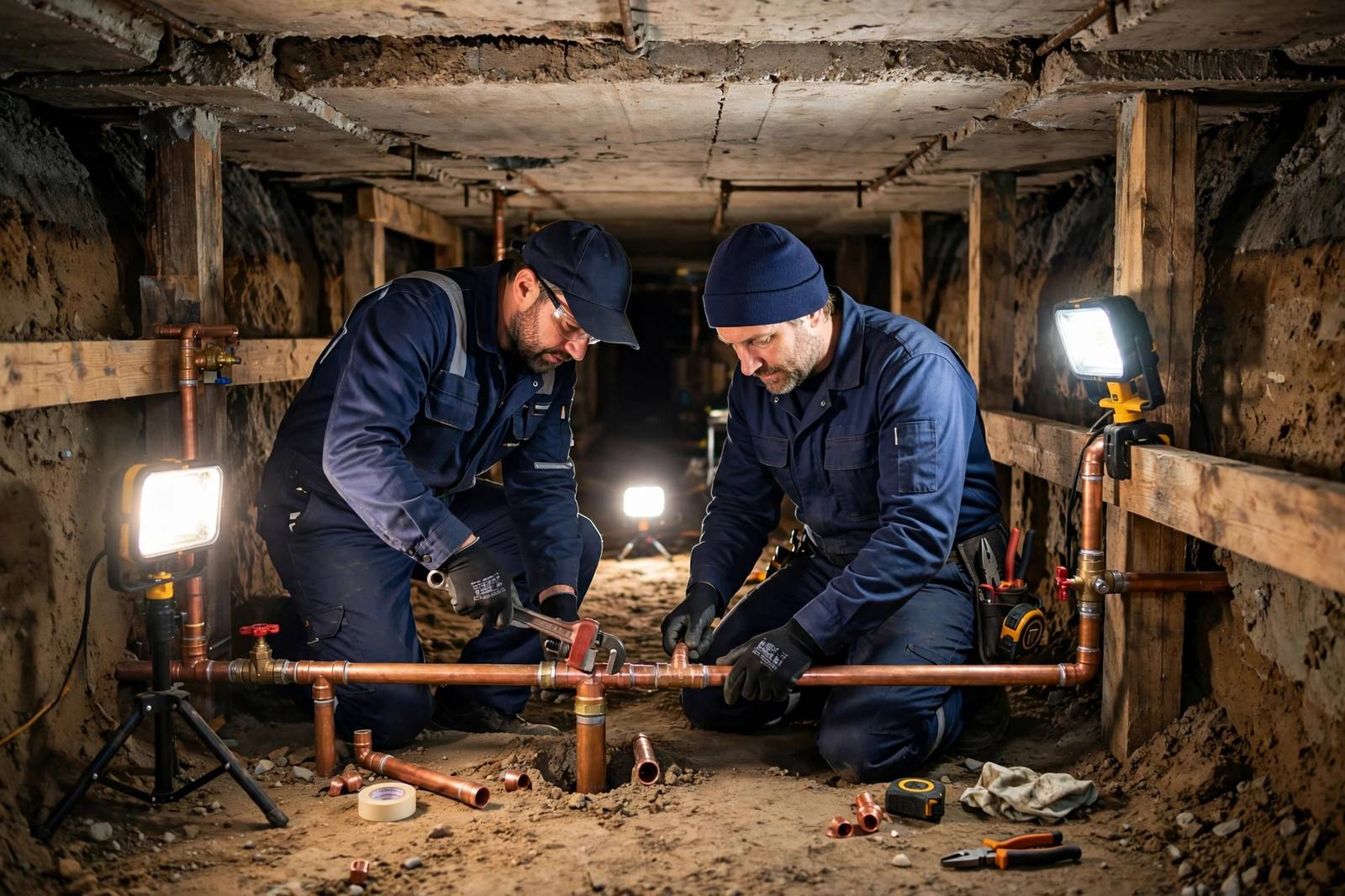
Once we've marked the leak, the repair conversation in San Jose usually comes down to three options, and the right one depends on the pipe's overall condition — not just the single failure. The overhead reroute is our most common recommendation and our most common repair: we abandon the failed underground line and run new PEX or copper up through walls and across the attic, dropping down to each fixture. Nothing breaks, no tile is destroyed, and the new pipe is permanently removed from the adobe clay and corrosive soil that killed its predecessor. Most single-story ranch homes — the dominant San Jose form — are ideal candidates, and the work typically finishes in one to two days. A spot repair suits a different situation: one isolated leak in a line that pressure-tests healthy everywhere else. We open a surgical section of slab, cut out the damaged segment, splice in new pipe, and patch the concrete. It's the least expensive fix, but it's only honest when the rest of the line has real life left. When testing reveals pinholes or thin spots along the whole run — common in 1960s-70s copper that's been flexing in adobe clay for fifty years — replacing the full line or repiping the affected system is the recommendation that actually ends the problem. Patching a failing line is just scheduling the next emergency. Tunneling from outside the foundation is available for homes where interior floors can't be disturbed, and epoxy lining can seal small pinholes in otherwise sound pipe. We present all viable options with itemized written pricing so the decision is yours, made with full information.
What Slab Leak Detection & Repair Costs in San Jose
Silicon Valley labor costs run well above the national average, and slab leak work is skilled, diagnostic labor — but catching a leak early keeps the numbers firmly in the manageable range. Electronic detection in San Jose typically costs $200–$550 for a one-to-two-hour visit covering pressure isolation, acoustic listening, and thermal imaging; tracer gas is added only when the situation calls for it. That fee is the cheapest part of the entire process and the part that prevents the expensive mistakes — chief among them exploratory demolition. For repairs, a spot repair through the slab generally runs $2,500–$4,500 including concrete cutting, the plumbing fix, and slab patching. An overhead reroute — what most of our San Jose customers choose — usually lands between $3,500 and $7,500 depending on how many fixtures the line serves and the complexity of the attic routing. Full or partial repiping costs more upfront but ends the recurring-pinhole cycle permanently. Tunneling sits at the premium end because of the labor involved. Finish restoration — replacing tile or refinishing hardwood over the work area — is sometimes quoted separately, so get that confirmed in writing. The factors that inflate a bill are consistent: multiple leaks discovered during testing, lines running under additions, or corrosion so advanced the line can't be saved. But the dominant cost driver is always delay. A leak caught in month one is a plumbing repair; a leak that runs for a season undermines soil beneath the slab and feeds mold within the EPA's 24-to-48-hour window, turning one trade's job into a restoration project. Our detection fee is credited toward the repair, and every estimate is itemized in writing before work begins.
The First Hour After You Suspect a Leak
The first hour after suspicion is when the cheapest decisions get made. Don't cut, drill, or jackhammer anything — homeowner demolition essentially never locates the leak and reliably increases the final bill, and breaching a slab blind risks electrical and gas lines. Instead, verify with the water meter: turn off every faucet, appliance, and irrigation valve, write down the reading, wait an hour without using water, and read it again. If the meter moved, water is escaping somewhere in the system. Then locate your main shutoff valve — typically at the front of the house or in the garage — and confirm everyone in the household knows how to operate it. Shutting off the water the moment a leak is confirmed stops the damage clock cold. Document the evidence with dated photos: warm floor areas, any cracks or stains, and the water bills showing the usage spike. That record is the backbone of any insurance claim, because carriers cover sudden accidental water damage far more readily than gradual seepage, and photos with dates tell a story adjusters believe. Call a slab leak specialist — not a general handyman — and ask for electronic leak detection by name. While you wait for the appointment, ease off hot-water use if the signs point to the hot line, and skip the drain chemicals; this is a supply-side problem they can't touch. Most of our San Jose calls resolve within 24 to 48 hours: detect and mark in the morning, repair complete by the next day. The smallest invoices always belong to the homeowners who called at the first warm tile.
Get a Pinpoint Diagnosis in San Jose
No jackhammer guesswork. Thermal imaging + acoustic equipment finds your leak within inches.
☎ Call (877) 762-1902San Jose Slab Leak FAQs
How much does slab leak detection cost in San Jose?
Electronic detection in San Jose runs $200–$550 and takes one to two hours, covering pressure isolation, acoustic listening, and thermal imaging. Tracer gas is used only when needed. The fee is credited toward your repair when you proceed with us.
Why does San Jose have so many slab leaks?
The soil. Santa Clara Valley's adobe clay is highly expansive — it swells with winter rain and shrinks through the dry season, rocking slabs year after year. That cyclical flexing fatigues copper lines, especially in the 1960s-80s tracts of Blossom Hill and Almaden built with pipe directly in the slab.
Can a slab leak be repaired without breaking the concrete?
In most cases, yes. An overhead reroute runs a new line through the attic and walls, bypassing the failed underground pipe — no jackhammer, no ruined tile. It's the most common repair we perform in San Jose's single-story ranch homes.
Does homeowners insurance cover slab leaks in San Jose?
Often partially. Most policies cover sudden and accidental water damage — ruined flooring, drywall, mold remediation — but exclude the pipe repair itself and damage from long-term seepage. Dated photos and fast reporting strengthen your claim. Keep every receipt related to the damage.
How long does slab leak repair take?
Detection takes one to two hours. Spot repairs usually finish in a day; overhead reroutes take one to two days. Most San Jose jobs go from first call to completed repair within 24 to 48 hours. Call early for same-day scheduling.
Does all the construction in San Jose affect slab leaks?
They don't cause them directly, but tech-boom infill construction — ADUs, additions, second stories — adds load and vibration near old lines, and new plumbing tie-ins can disturb aging joints. If your slab leak appeared after nearby construction, mention it during detection.
Nearby Cities
Slab leak pros nearbyBakersfield
Slab leak pros nearbyFresno
Slab leak pros nearbyLos Angeles
Slab leak pros nearbyRiverside
Slab leak pros nearbySacramento
Slab leak pros nearby
Keep Learning
Slab Leak: Tunneling vs Rerouting — Which Is Better?
Tunneling vs rerouting for slab leaks: real costs ($4k-$8k vs $2.5k-$6k), timelines, disruption, and when each method wins. Honest…
Slab Leak vs Foundation Leak: How to Tell the Difference
Slab leak vs foundation leak: symptom-by-symptom comparison, free diagnostic tests, and cost differences. Tell them apart before c…
Water Line vs Sewer Line Slab Leak: How to Tell
Is your slab leak on the water supply line or the sewer drain? Learn the symptoms, DIY meter tests, pro diagnostics, and repair co…